Showing posts with label China. Show all posts

28 July, 2007

thesigns

one of the great things about all our travels has been the chance to be immersed in another language. although we learned precious little of any of them, it is really cool to hear so many unfamiliar sounds and see foreign writing, much of it in our case in totally different scripts. Since it's difficult to give you the sounds of all those languages, i thought i'd at least give you the sights. so far, we've been to Taiwan, where they speak what we usually call "Mandarin" Chinese and Taiwanese; Thailand, where Thai is spoken; Malaysia, where they speak Bahasa Malay and English; Singapore, where English is the administrative language, Malay the national language, and Tamil and Chinese also considered official; Indonesia, where Bahasa Indonesia is spoken; Hong Kong, where it's Cantonese and a lot of English; Macau, where Portuguese and Cantonese are spoken; Mexico, where they speak Spanish; Japan, where Japanese is the order of the day; Mainland China, where they also speak Mandarin, but have changed some of the written characters; Korea, where Korean is spoken; Britain, where real English still generally prevails, along with a bit of various Gaelic tongues, like Cornish, Welsh or Scottish; and France, where the people speak French.


signs of our times, clockwise from top left: French in Paris, English and Chinese in Hong Kong, Welsh and English in Conwy, Wales, Korean in Seoul, Chinese in Beijing, Japanese in Nagoya, Portuguese and Chinese in Macau and Spanish in Puerto Vallarta. in the background is a sign from Georgetown, Malaysia, written in Malay. click the picture to enlarge it. below, some Thai script seen outside a government building in Bangkok.


the longer we spent in a place, the more familiar its language became; we got to the point in Taiwan and Japan where we could read and understand a few things, though generally Chinese and Japanese are still alien to us. good thing you can almost always find someone who speaks some English and wants to practice, even in the most remote corners of the world.

18 February, 2007

theacrobatics

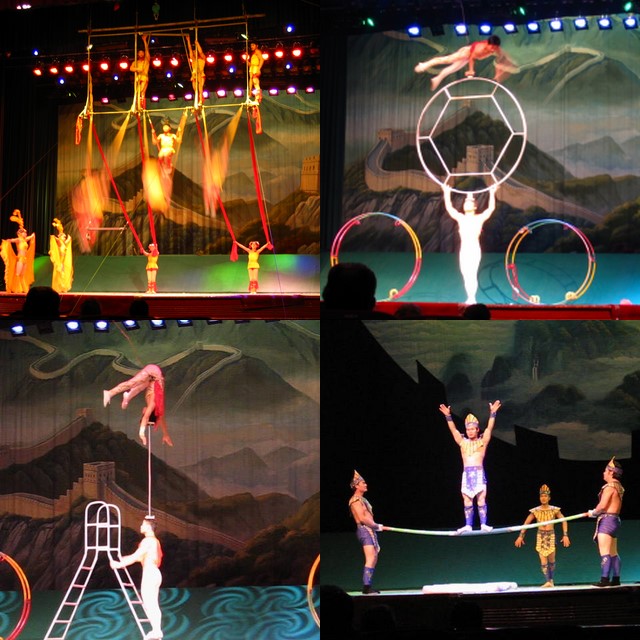
it's about time to finish up the last of the posts on our trip to China in November. there are enough touristy things in Beijing that we still had plenty to see in our last few days, but probably the most entertaining of those was the sweet Chinese acrobatics show. with the cheap set dressing and unbelievably cheesy music, the first 15 minutes of it was so ghetto i thought we were somehow back in Macau. but pretty soon i got into the swing of things, the quality of the acts themselves overshadowing the crummyness of the surroundings.


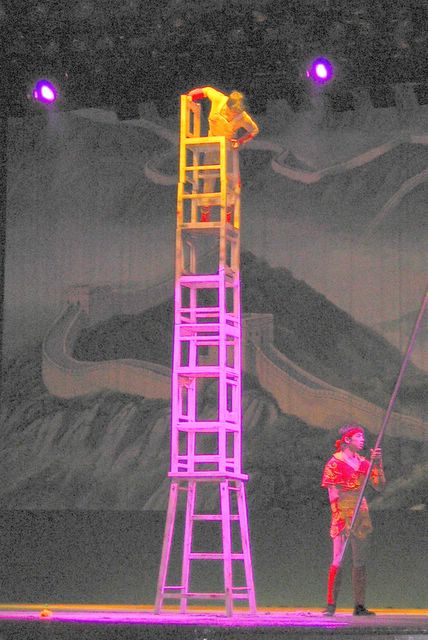
some scenes from the highly entertaining acrobatics show, including, clockwise from top left: a lot of aerial spinning, set to the cheesiest music imaginable--like a pepped up version of some Maoist marching band tune; a metal circle spins while the guy on top remains stationary, held up with just one of his own arms; a guy dressed like Pharaoh bounces on a stick before jumping up to complete all kinds of flips before landing back on the stick; and a man who is very careful with stairs, given the other man perched on his head. below, an act that actually had me worried: until this point the fellow climbing the chairs had no harness. a little after this picture was taken, he clipped in, put a couple more chairs on and then did some handstands and such on top of the lot. he was so high you could barely see him behind the top curtain of the stage.


the guy pictured above actually did have me pretty nervous, a vicarious worry i'd never experienced on behalf of a stranger before, at least not in a show. the crewmember brought him chair after specially designed chair, which he kept stacking one on top of the other, climbing the growing tower as he did so. at first it wasn't so special, but pretty soon that tower was several times higher than he was tall and started to look a bit rickety. and all that with no harness. for the last couple of chairs, he did clip himself into a wire, but by that point the tension was so high we would still have screamed had he fallen. in the event, he didn't let that happen, and this probably ranks as the best stunt I've ever seen live.

after that, we still had a few parks to see in central Beijing, including Jingshan and Beihai. Jingshan Park sits directly north of the Forbidden City, and is centered on a hill that gives a great view of the palace. there are several pavilions at the top of the hill, and even on the weekday we were there, the whole park was bustling with all kinds of people either sightseeing or just relaxing. it happened to be a good day for both these pursuits, being not only sunny but one of the very few during our time there when the air was clear enough to make a short view possible.


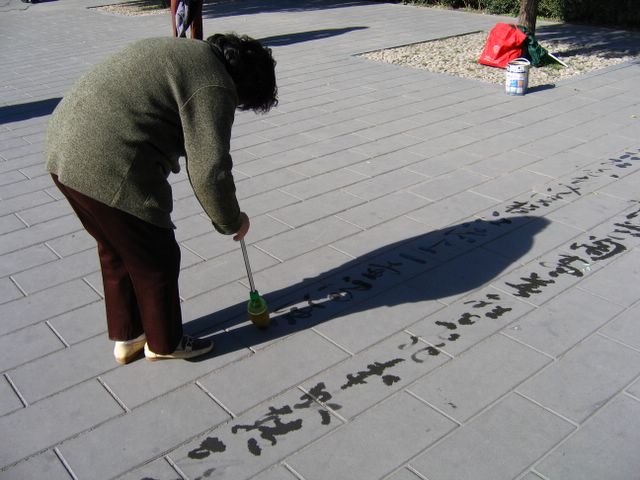
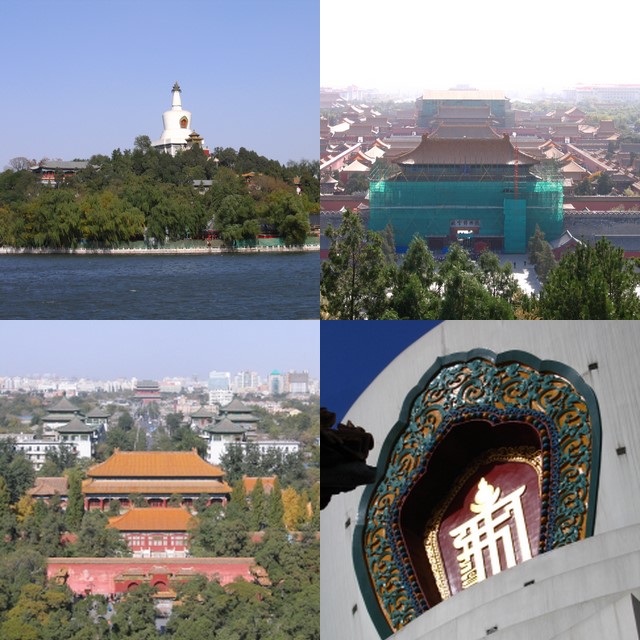
a woman practices water calligraphy in Jingshan Park. her large brush has a chamber to store water just above the bristles, and with these she writes fast fading but beautiful Chinese characters on the concrete flagstones. below, views from Jingshan Park and of the White Dagoba at Beihai Park.


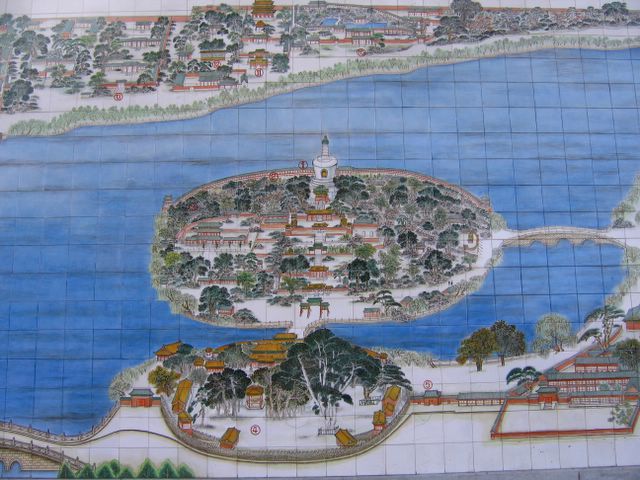
just next door to Jingshan Park is Beihai Park. the "bei" in Beihai is the same as the one in Beijing, and means North. there is also a Zhong- and a Nanhai, Central and South hai, respectively. unfortunately, these latter two beautiful lakeside areas have been taken over by the Communist Party and are now used as the gated community of its leaders. decrees are often said to emanate from Zhongnanhai, as it is known, much as our laws come from "Capitol Hill" or "Downing Street", so the area also serves as the de facto center of the government. in any case, at least they left Beihai alone. there you can ply the lake in cheerful communist-red and yellow paddleboats or hike to the top of another small hill and take in the view from the ornate White Dagoba, pictured below on a tile map of the park.


tile map of Beihai park, in Beihai Park, showing the location of the Buddhist's White Dagoba.

we didn't do any lake plying of our own and in fact kind of whirlwinded these last two parks, mostly just to say we had seen them. it was very windy and quite cold, so we knocked them out fast and went back to the hostel to pack for our return to Japan, which itself was pretty uneventful. we were, by and large, glad to return to Japan, happy to say goodbye to the filthy air and ubiquitous street vendors, to say nothing of the hordes of ill-mannered people in China. this particular loss was brought dramatically into focus for us on the train back from the airport: where only hours before we had fought tooth and nail, against blue-hairs and brutes alike, just to get on a bus, now a man whose phone rang got up and moved to the end of the train car before feeling okay to say moshi-moshi. it was nice to be back, but China does possess a certain amount of colorfulness and a sense of character that Japan lacks. nevertheless, it's a character that I find best taken in small doses, so until I need my next fix of nonstop temples and endless seas of people, I bid the People's Republic a fond farewell.

10 January, 2007

theterracottaarmy

one of the best parts of our Beijing trip was not even really part of our Beijing trip. towards the end of our week there we managed to secure sleeper berths in a very nice train that ran overnight to the famous ancient city of Xi'an--"Western Peace". famous to Westerners only since the 1970s, really, because at that time some Chinese peasants digging in the dirt of their (or the Communist Party's) fields came across what has been hailed as the archaeological discovery of the century: a mass army of terracotta warriors all buried near the tomb of Emperor Qin.


the sign on the side of our train that told us we were going from the Beijing West (Beijingxi) station to Xi'an, and the train itself, one of the newest (and i’m sure nicest) in China.


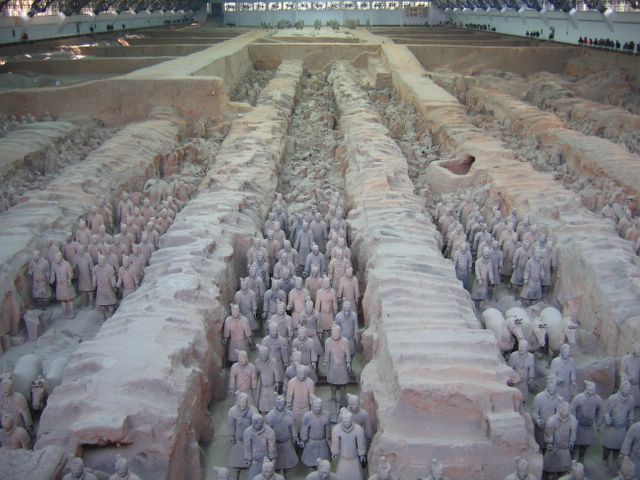
not wanting to appear commercialistic, the Party took its sweet time in excavating the site, possibly to make it look like they weren't pandering too much to the needs of the bourgeois pigs that began flocking to the huge new tourist site. in any case, 30 years on the area is still not completely excavated, though there are now three different buildings covering up separate digs. all but one of these are actually fairly unremarkable, the viewing areas are high above dimly lit pits in which lie only broken fragments of warriors, for the most part. but in the main building, which resembles a very large Quonset hut, the treasures really abound, and are illuminated by bright sunshine streaming in the high windows. this is where all the pictures you see in National Geographic were taken: rows upon rows of soldiers, all in their ranks and ready for battle. it really is quite an awesome sight.


the army of Qin arranged in their ranks.

Xi'an itself is about 800 miles Southwest of Beijing, and the warriors are about an hour's bus ride out of town, seemingly in the middle of nowhere. apparently Xi'an was an ancient capital of China and Qin had himself buried at the foot of some hills a couple of kilometers from the amassed army. i gathered that they plan to excavate the large grass-covered mound that marks his tomb as soon as they can figure out how to do it without destroying all the artifacts in the process. that should guarantee a steady stream of tourist dollars for many years to come. along with a great deal of Chinese cultural education being disseminated to the capitalist peoples of the world, of course.

the rest of the warrior compound is fairly unremarkable, with a very strange "movie" which seeks to reenact some of the ravages that time and the occasional crew of pillagers have exacted on the statues, along with a couple of gift shops and more of China's ubiquitous hawkers and "official" tour guides. the small museum-ish areas are of little help to those who don't read Chinese (or have an official guide...), and once you've seen the warriors, you've pretty much seen it all. it's not really an all day type of thing, but it may be when the hordes of new shops they are constructing on the site are completed, probably just in time for the 2008 Olympics.


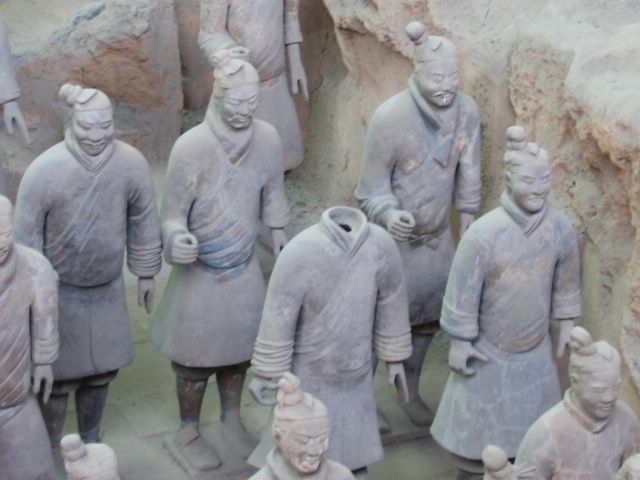
various views of the treasures at Xi'an, including one of the replica soldier Jill and I were thinking of adopting, and a close-up of the famously unique warriors. each has his own individual features and was uncovered holding a weapon befitting his rank and station, though the site administrators have taken them all away for "storage" or the Olympics or something like that.


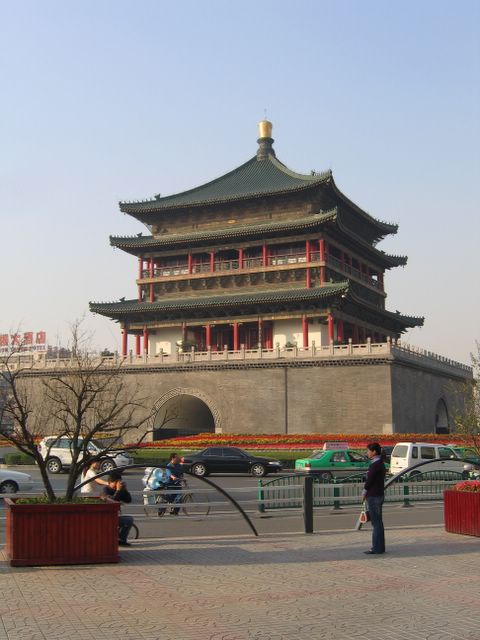
so Xi'an was a whirlwind trip, but we were left with some time after the warriors to explore the city itself before our train out the very evening after our train in. as it turned out we would have been grateful not to have had that time, Xi'an being really just another large city whose major distinction may be that it was somehow even dirtier than Beijing. it's a little difficult to sleep on a moving train unless you start out pretty tired, so our wanderings around town were slow and sluggish, and led us only to the "Small Bell Tower", pictured below.


Xi'an's Small Bell Tower, an apparently fine example of those found in many Chinese cities.

there didn't seem to be a whole lot to see in Xi'an, but we got a pretty decent view of what there was from the guy who gave us a ride to the bell tower in the back of his three-wheeled scooter, which we later realized was actually his motorized wheelchair being put to profitable use. after another McDonald's lunch we made out several hours early for the train station on foot, not feeling like we would be missing much if we just sat there waiting. we were fortunate to have bought some kind of tickets that allowed us to wait in what I suppose was meant to be a VIP lounge, which we welcomed after having seen the unruly crowds amassing around the station. though we were used to Beijing manners by this point, I don't think we had seen people spit on the floor inside a building until Xi’an station.

but we had a good time in our VIP-type lounge. we met some folks from the States--Southern California even--and my favorite, some from right back home in Japan. there was a large tour group that filed very quietly past us, so we knew they weren't Chinese, and the travel agency stickers on their suitcases confirmed their nationality. we said hello, in Japanese, to a group of about four older ladies, and then I asked them, again in Japanese, where they were from. one of them leaned forward and, obviously proud of herself for so quickly ascertaining that we were not actually Japanese, said: “Japan”. well, it was very nice of her, and in any case, pretty soon we were onto our train, in a nice clean sleeping cabin, where this time we passed the night's journey back to Beijing quite restfully.

18 December, 2006

thegreatwall

no trip to Beijing would be complete, one supposes, without a visit to the Great Wall of China, one of the alleged wonders of the modern world. i understand that many people also allege that said Great Wall can be seen from space, but according to the sources i consulted, either those people had never been to space or had been relying on powerful optical enhancement devices while they were there. i imagine the former is generally the case, and while i, too, fall into this category of person, i can say that at times the smog was so bad that it was difficult to see the wall half a mile away. so i suggest that the common perception may be a myth.

the wall itself, however, is most certainly not a myth; nor, unfortunately, are the epic crowds that ply it day in and day out. we went on a weekday in November and there were so many Chinese tourists that some sections were almost impassable.


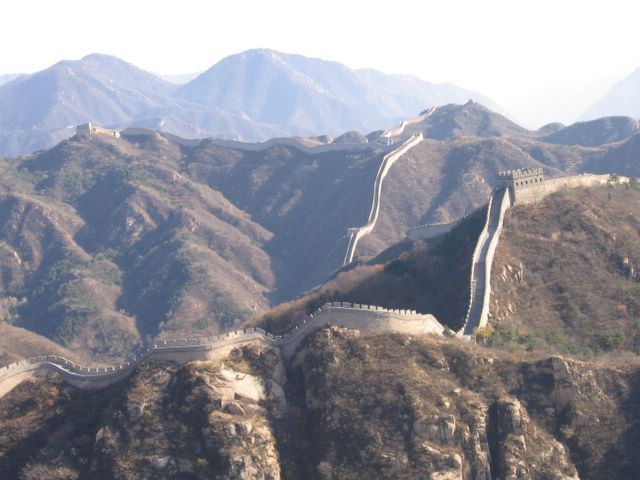
Jill and i on a mercifully uncluttered section of the Great Wall, and then a section that was, at this moment in time, visible some distance away.


the Great Wall is classified into various geographical sections, and in order to avoid the dozens of "student" tour guides who offered us a private car for the day, we took the bus and had to go to the most crowded (and least-authentic) section of all, at Badaling. oh well, we just wanted to say we'd seen it. of course, just because we'd managed to steer clear of the "tour operators" didn't mean to say we didn't get taken a couple of times. even the official city bus we took pitched us tickets for this weird "cable car" that was was more like a chain of plastic toboggans that hauled us up to the base of the wall. upon arriving we discovered we could have walked in a matter of minutes. still, we would then have had to traipse past dozens more sidewalk vendors trying to sell us all manner of junk, from Chairman Mao quotation books to near-life size brass replicas of the wall. on the way back down we did indulge ourselves in several of their wares, including a couple of Mao hats and some awesome T-shirts. one of them had a screen printing of Mao's head on it, which image came off in the dryer, and another dyed all my clothes in its bright red ink when i threw it in a regular load. i can't remember the last time i bought a garment that wasn't color-fast, so i was pretty upset about it. given that the shirt only cost a buck, i guess i should have known though.


clockwise from top left: Jill rides the cool toboggans to the base; the hordes of tourists even on an "off day"; an artisan prepares a traditional Chinese watercolor of the wall; and a remote view of a high section of the wall. too many others lay between us and this section for us to bother trying to reach it.

in any case, the Great Wall was pretty cool. it snakes over the hills as far as the eye can see, occasionally punctuated by watchtower-looking structures. it's hard to imagine how it could have been continuous actually, but since so much of it has been reconstructed it makes sense that there is much missing. among the high points of the trip, though it wasn't actually on the trip to the wall itself, was having a picture of it painted on a scroll later in the day.


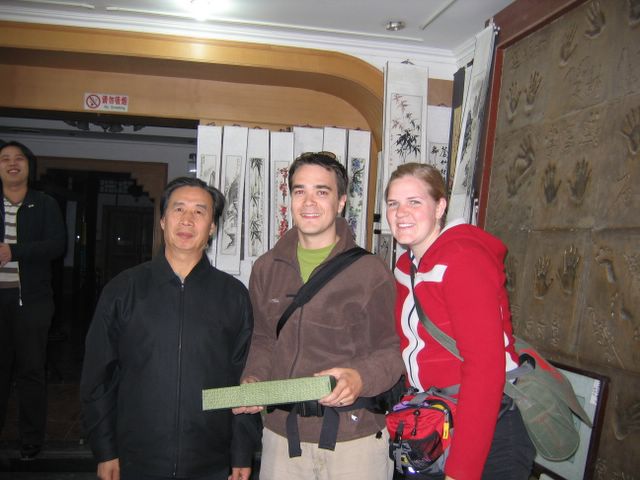
our Great Wall scroll being painted, and us with the artist who produced the work for us very much on the spot.


the bus back to town dropped us near a kind of trashy shopping area which we decided to exploit, and where we found a place selling traditional Chinese watercolor scrolls. already having a couple of those from Taiwan, we weren't really in need of more, but thought it would be a good way to memorialize the Great Wall trip since the souvenirs there had been so awfully gaudy. the only picture they had of the wall however, was on a loose piece of rice paper that had not been fastened into a silk scroll, so we made for the door. not wanting to lose a sale, the woman who sort of ran the place without really seeming to do anything herself quickly volunteered a guy to paint one for us, on the spot. as he prepared to do it, we both thought he was going to back out, because he kept making like he was going to begin and then stopping. but the lady gave us each a handful of sunflower seeds and pulled up a couple of chairs and pretty soon the guy was knocking out a very impressive rendition of the picture that obviously he had originally painted on the rice paper. i'm a bit bummed we didn't get his name, but we did get a picture with him, and the picture he created now hangs on our wall to remind us of what you really don't need to go all the way to space to see.

27 November, 2006

theview

back to Beijing. before venturing farther afield to see the Great Wall and the terracotta army (details coming soon), we saw some of the other big draws in and around town. one of the most impressive was the Summer Palace, a place as big or bigger than the Forbidden City, that would equally take a day or more to see in its entirety. situated Northwest of town, the palace is a complex of buildings set mostly on two edges of a large lake. not surprisingly, given the name, the imperial families would come here during the summer to escape the brutal heat of the city, and though many of the buildings are quite samey looking, the whole site is quite beautiful.


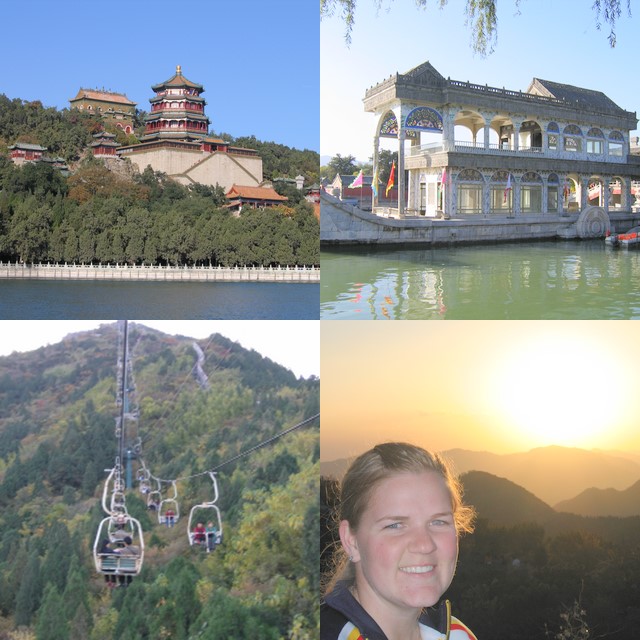
clockwise from top left: one of the palace buildings as seen from the lake; a marble replica of the boats that used to ply the lake for the emperors; Jill and the sunset from the tops of the mountains; and the chairlift up to the top of Fragrant Hills Park.

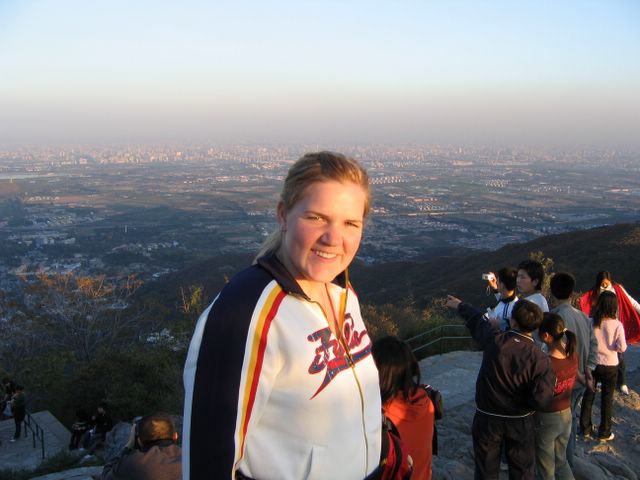
from the palace complex, however, we ventured further out of town to what became a highlight of the whole trip: Fragrant Hills Park. just why they're called the fragrant hills i'm not sure, something to do with what happens to the armpits of the many thrifty souls who try to climb all the way to the top i guess. as for us, we took the chairlift that is apparently the pride of homegrown Chinese engineering: there's a big sign at the top that proclaims it to be the first all-Chinese built, made and installed ever. it is pretty impressive; we were not expecting it to cover so much distance or take as long as it did--about 20 minutes--to get to the top. the view from there was worth all that time and the five bucks or so we bourgeois pigs spent on the ride. Beijing is a huge, and a sprawling city, extending as far as the eye can see in about a 150-degree arc. of course, with the filthy smog the eye can't see too far, but there again is the beauty of Fragrant Hills park: you know you're above that thick layer of grime that otherwise would be the constant fodder for your poor, blackening lungs. mine still haven't forgiven me for taking them on this vacation.


Jill looks so happy not only because she's with thejayfather, but because she's taking a brief break from breathing all that crap in the Beijing air below Fragrant Hills Park. smog this bad makes the idea of sucking on a Peterbuilt exhaust seem appealing.

truly, even Japan's surprisingly dirty air was nice to come back to after inhaling Beijing's for so long; i really can't say enough bad things about it. they may be able to slap a few coats of paint on some key structures by the time the Olympics roll into town, but i'll dance naked through the insanely chaotic streets of that city if they're able to clean up the air in time for the games. one of the reasons it can be so bad is that China's capital is quite rapidly being taken over by the Gobi desert, whose incursions from the North even the great Great Wall hasn't been able to check so far. each summer, apparently, the city suffers from near-drought conditions and violent sandstorms sweeping through town. we didn't experience anything as dramatic as described in the guidebooks, but we were often able to taste the grit in between our teeth. we saw numerous people walking around with their whole heads covered by thin linen or silk scarves to keep the debris out.

what that means is that Beijing is reliant on other parts of China for its water and food needs. it wasn't always this way, and the new forced humility for the proud capital may be explained by the hard line the conquering Communists take against religion. one of the great symbols of Beijing today is the Hall of Prayer for Good Harvests, located in the quiet Temple of Heaven Park, to the South of town. once again, the ruling party was foresightful enough to appreciate the tourist revenues this place might generate in spite of its religious purpose, but perhaps if they allowed those prayers that were intended to be offered there, the city would struggle less for food and water needs. who knows?


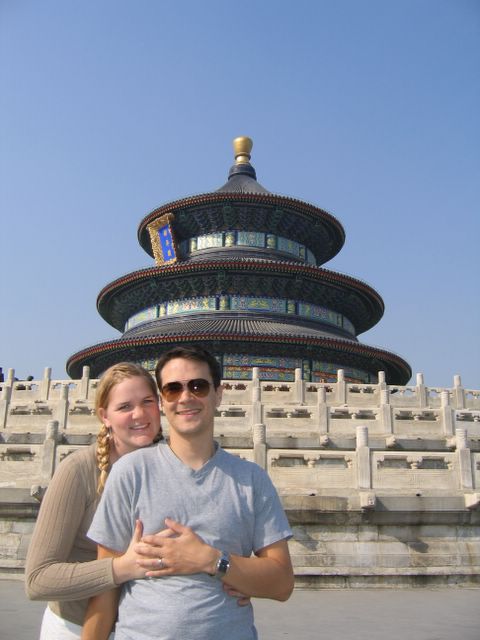
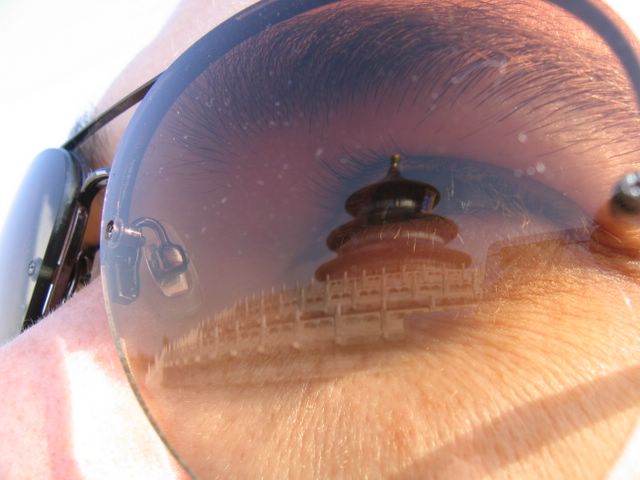
Jill and i stand in front of the Hall of Prayer for Good Harvests, at the Temple of Heaven, one of the few sights already looking ready for the Olympics; and me contemplating the Hall's greatness, and perhaps offering a prayer of my own...


in any case, the Temple of Heaven complex is one of the most enjoyable in Beijing, if only because of the small entry fee they charge, which seems to have the effect of keeping out most of the hawkers and hustlers--a seriously welcome break. there are so many scams going on in Beijing, all of which we were fortunate enough to avoid. one that almost got us on our first or second day was the well-meaning, struggling college student who is having a display of his artwork and will get credit if you come along and look. apparently, once you go into wherever they are set up, you are virtually held hostage until you can come up with a way to fork over big bucks--like thousands of them--for seriously bad "art". but hey, you get to use their phone to call your bank or credit card company or whatever. the weird thing was that the scam artists would be everywhere, inside legitimate tourist sights and everything.

as were the street sellers, though they are a whole other issue, and just one of the reasons i kept having bad flashbacks to Tijuana the whole time i was in China. more about them later; for now i leave you with a few more views of the beautiful sights described (so beautifully) above:


a bamboo forest at the Summer Palace; the nighttime view of Beijing from the top of Fragrant Hills Park; and a larger than life decorative knot hanging at the Temple of Heaven. you can't really tell, but this thing is about two or three times my height. some kind of boyscouts they have here.

20 November, 2006

thesquare

our first Beijing outing, and the subsequent staging ground for most of our trips, was to Tian an men square, or the square of the gate of heavenly peace. like Beijing itself, the square is much bigger than you can gather from looking at maps beforehand, and beyond its own borders it seems to merge almost seamlessly with the Forbidden City to the North.

the main attraction of the square proper is the Chairman Mao Mausoleum, which sits roughly in the center. it's free to go in, which i did, only to learn that the freeness is a scam designed to nickel-and-dime unwitting Chinese tourists to death. even after all Mao did to... sorry, for, his countrypeople, they still line up in droves to be hurried past a glass case that contains what looks suspiciously like Madame Tussaud's vision of the Chairman, draped in a Soviet flag. before going in, however, the faithful are supposed to pay ridiculous fees to leave their bags at an off-site storage facility (for security), spend three times an ordinary bus fare to buy a yellow flower to drop at the feet of Mao's statue (which flowers i'm certain are collected up and resold later), and then splash out another whole bus fee on a flimsy propaganda pamphlet. and that's all before you get to the huge shop full of the gaudiest and tackiest Mao "souvenirs" and are then ushered back out into the daylight. i can understand why the Chinese go there, but i can't really fathom why there aren't more people cursing the Chairman's infamous name than paying homage to a ridiculous statue of him. the whole time i was in there i struggled to think of someone else who had perpetrated greater crimes against his own people. in vain.


Jill stands outside the Chairman Mao Mausoleum, much oversized to match the man's ego.

so there's no love lost between Mao 'n me. but the size of his personality cult is amazing, as is the picture of him hanging over the famous Gate of Heavenly Peace. that's the same heaven, i suppose, that those practical Commos aren't supposed to believe in, unless of course they smell future earnings from tourists. most of the big tourist sites in Beijing are of a religious or some other such quality strictly anathema to the Communist credo, but they don't seem to have a big problem buying off their consciences with your dollars. in fact, there's a sense of the money grab going on everywhere, and they certainly are good at planning for future sell-outs. take the Olympics, for instance. to look around Beijing you'd think the Chinese were related to Homer and Plato, the amount of propaganda they have up about the games. the canny observer will note however, that the average "man on the street" doesn't seem to care one iota, so to speak, about les jeus, or about the official bid to bring some credibility to the otherwise integrity-bankrupt nation.


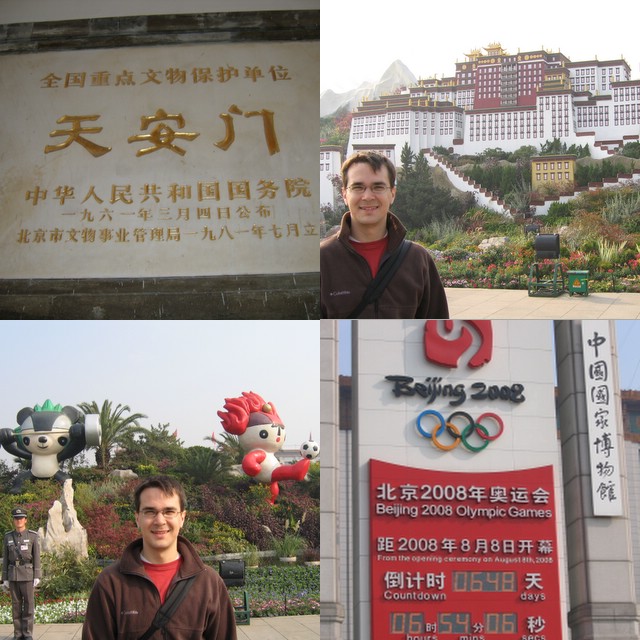
the characters in marble say Tian an men, which has been translated to mean Gate of Heavenly Peace. then there is the strange inclusion of a Tibetan monastery with the Olympic exhibits ornamenting the square.

nevertheless, i do have to give some credit to the Olympic planners for the clever names they gave to the five mascots. there's a beibei, a jingjing, a huanhuan, a yingying and a nini, all different colored bear-like animals. if you take just one of the syllables from each name and put it together, you get beijing huanying ni, which means "Beijing welcomes you". okay it may well be that the names are less clever than i think i am for figuing that out, but you can make your own mind up about that.

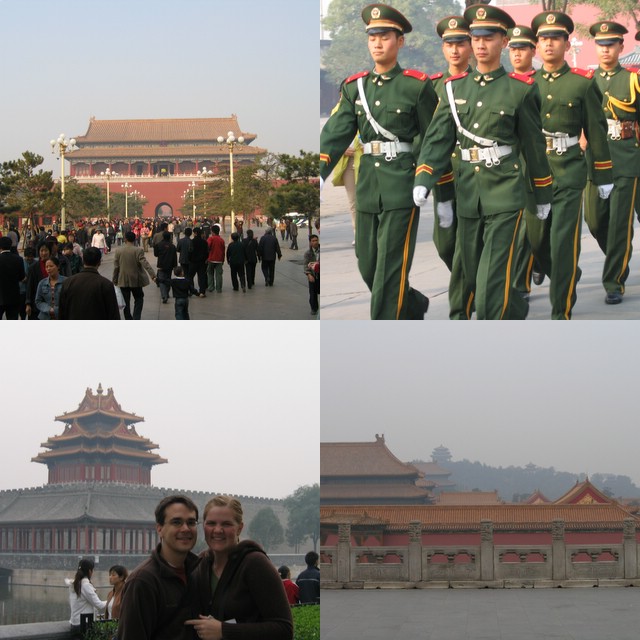
across the main street to the North of the square stands the Tian an men itself, which is, to my mind, the symbol of Beijing today. adorned with Mao's image it, like the Forbidden city beyond and all else in this part of town, is heavily guarded by very young-looking men in shockingly ill-fitting and ragged uniforms. or multiforms, since there are so many different official security services with a hand in ensuring your safety.


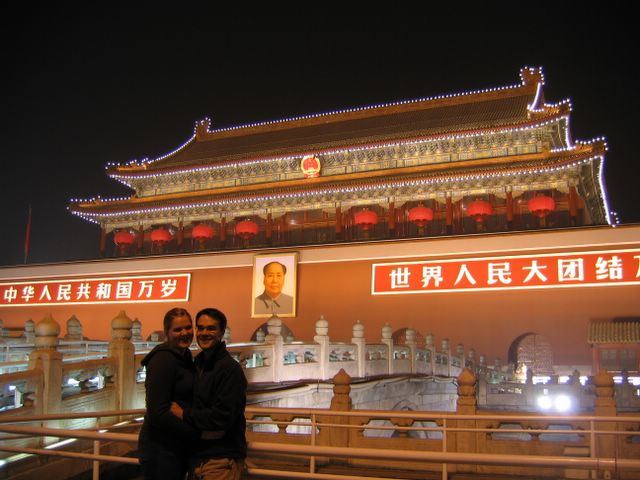
our visit to Uncle Mao at the Heavenly Peace Gate, and various scenes from inside the Forbidden City that lies beyond.


the gate is quite impressive, but not like the sprawling Forbidden City behind it. it would literally take a day or more to explore the whole vast campus, even allowing for the number of buildings that were shut down for Olympic refurbishing. these included the biggest and most important ones, of course, so we were able to race through in a comparatively scant few hours. it really is a city in there, though no actual Chinese people were ever allowed in there while the emperors were still around. quite a playground, and one that the new Communist emperors wisely stayed out of, giving the overwhelming bourgeois connotations of the place. nevertheless, they now all live in what is often referred to as the New Forbidden City, Zhongnanhai, right next door. that and much more on the apparent contradictions in official communist policy still to come.

05 November, 2006

thenewsfromChina

thanks to China's impressive countrywide internet firewall, i haven't
been able to check the blog the whole time we've been here--too many
references to Taiwan on it, i assume. nevertheless, i did want to
give a little info on what we've done here, if only to remind myself
which pictures to put up when we get back.

we stayed mostly in and around Beijing, visiting the big sites like
the Great Wall and the Temple of Heaven, but we did manage to get out
to Xi'an, a city about 750 miles Southwest of here that is famous for
its underground army of terracotta warriors. they date back about
3,000 years, to the time of the Qin (say "chin") Dynasty, and they are
buried near the tomb of one of the Qin emperors. it is quite a cool
site, and was worth the trip despite the distance and the near dearth
of other things to do in Xi'an.

and despite the air quality, which is just as bad there as here in
Beijing. for all the complaining that people in Southern California
do about the smog there, one trip here would be enough to shut them up
forever. it's unbelievable. but there are many cool things to see
and do, and many great bargains to be had, like our "North Face" coats
and our "Sony" memory sticks. good times and good prices--bargaining
is fun. we also went to see a cool Chinese acrobatics show last
night; not quite like the Amazing Chen from the movie Ocean's 11, but
very entertaining nonetheless. pictures from that and all else soon
to follow.