14 February, 2010

thepenes

so we had arrived in Puno and witnessed a strike, had got some lunch and taken a quick look around, but other than that we had a whole day we hadn't planned to have in this town and we didn't know what to do with it. so we hit up some tourist agency to see what kind of cultural things we had missed on the way down from Cuzco and what may be near enough to do in a day, and as luck would have it we weren't disappointed.


on the altiplano, you may grow sturdy but you don't grow tall: Jill and i at a bizarre roadside attraction on a hill overlooking Lake Titikaka.

we were able to book an afternoon tour to a little place called Sillustani, just off the road back to Juliaca. there we would be taken to see the remains of some ancient funerary structures of the Colla people, a group of the indigenous Aymara who, along with the rest of them were conquered by the mighty Incas who rolled into town in the 1400s. the Collas lived on very high, windswept plains and buried their nobles in stone towers, the better to worship them, you see. each tower appears to have been a mostly hollow cylinder whose height indicated the relative importance of its family of inhabitants, with a beehive shaped stone mound inside that actually housed the mummies. it is thought that the beehive shape was intended to represent femininity, while the cylinder evoked a more masculine idea. and that's what made our tour so comical, and not to the youngest members of our party either...


above, clockwise from top left: Jill with the roadside puma, an important animal in the Inca culture; Jill taking in the eerie desolation of Sillustani's high plateau; our tour guide, explaining the penes over and over again; the 2-Sol (67-cent) picture of Jill with the baby llama, cheap at twice the price; and some hardy-looking, red-cheeked children of the high Andes. below, Sillustani was bleak in a beautiful way, feeling somewhat medieval to me somehow.


the problem with tours is that you usually have to take them with other people, and generally there are bound to be some you'd rather not travel with. unfortunately, this tour was no exception, and the problem pair in this case were an old couple from somewhere in Spain, so you wouldn't have thought they'd have language problems. actually the guy seemed alright, but he was hard of hearing and so maybe it was his fault that his wife was as loud and terrifically obnoxious as she was. when we were standing up on the plain and Jefe was explaining what the so-called chullpas were, he would get a bit shy and give all references to phalluses in a rather timid voice, so much so that the the Spanish guy couldn't hear him. he kept asking his wife what was being said, and as we were standing on what was supposed to be hallowed ground, the cold wind blustering through the tall montane grass, she finally gave in and yelled at him: "como un PENE!" i was glad i knew enough Spanish to be amused at the exceedingly inappropriate way old ladies sometimes talk.
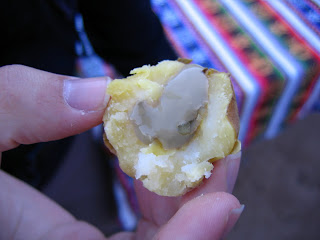


above, who needs gravy for potatoes when you've got... clay? below, clockwise from top left: Jill and i with the Familia Vilca of Atuncolla; Jill with their pet alpaca (note the stubbier nose and shorter ears than on a llama); myself and Senor Vilca with the same alpaca and a couple of llamas; some pet--and i use that term very loosely here--guinea pigs, the nearest of which is very pregnant; and the entrance to the little village of Atuncolla.


if people are going to be extremely annoying, at least they should provide some entertainment, even if it only lasts a few moments. but the remainder of the trip we distanced ourselves from the Penes so as not to offend our new friends the Vilcas. after the plains of Sillustani, we stopped in a small village named Atuncolla, where the few residents lived simply and mostly self-sufficiently, it seemed, their children wearing handmade traditional clothes and sporting the chapped red cheeks common to young inhabitants of the altiplano. we toured the housing compound of the Familia Vilca, which consisted of a courtyard enclosed by a wall of mud bricks and a few small structures, each with its own purpose in mind. they had their own living quarters, some guest quarters that could be rented very cheaply if one desired such an authentic experience, a cooking area, a sort of shed, and a hutch for the guinea pigs. to avoid being indelicate about what the guinea pigs were for, i will say that the Vilcas were feeding their guests on this tour; we weren't treated to anything quite so lavish, but i hope you get the idea. instead, we had some homemade cheese, which i understood came from either the llamas or the alpaca, some potatoes, and some clay. yes, they made us a steaming pot of clay. to eat. it was grayish brown and fairly runny, and we were to break the small potatoes and eat them with some clay on top, like it was some sort of gravy. it actually wasn't bad at all, but we really didn't know what the point was or who first figured out that eating clay was a great idea. as it turned out, it may not have been in my case, as my guts were beginning to feel a bit the worse for wear from our strike-side lunch, but what i began feeling that evening was just the beginning and would make the next day's trip far worse than even the Familia Pene could have done.

27 November, 2009

thestrikes

we've found it's best to maintain some flexibility in travelling. never has this rule of thumb been more important to us than when it came time to leave Cusco. Jill had booked us on a bus that would leave around 7am and take something like 12 hours to get to Puno in the southeast of the country, stopping all along the way at sites of interest. we are pretty organized as travelers and we had arranged for the hotel to have a taxi waiting for us at around 6:30 to take us to the bus depot, and all was going according to plan until we arrived at said depot and found... nothing. it turned out to be some guy's house and the taxi driver started honking and yelling to get someone to come out, which the very sleep-addled guy finally did--on the balcony, at least. he was good enough to tell us that the bus wouldn't be departing that day, and that he'd be grateful if we kindly got lost.

Jill speaks good enough Spanish to get us around, but we had to confer with the taxi driver on the details of what was going on; he let us know that there was a strike of various groups of transportation workers, and that they had blocked off all the roads into and out of Cusco and thus that no long distance transit would be occurring that day. clearly the driver had known all about this and why he didn't think--or one of the hotel staff didn't think--to tell us about it when we told them we were getting a long distance bus to Puno is still a little mysterious to me. in the case of the driver, i suppose that decision turned out to have a small financial benefit, because he must have known we'd ask him to take us elsewhere and he would be able to renegotiate his rate with virtually captive passengers. as it turned out, he was actually far less unreasonable than he could of been and tacked on a trip to the airport for only about $1.50.


the tiny airport we weren't yet supposed to see, in Juliaca, which is a 45 minute taxi ride up the road from Puno; below, the aeroplane we weren't supposed to take--and almost didn't get to!


this was the first time either of us had been in the situation where we were just going to show up at the airport and try to book a flight at the counter, and it began to feel like we were reenacting some scene from a predictable movie. we split up and went to the counters of the different airlines to see what they would charge to get us to the nearest airport to Puno, which is in Juliaca. as Cusco is at such high altitude planes have a hard time taking off in the thin air--especially as the air gets warmer and thus thinner as the day goes on--so almost all the flights out of Cusco leave very early in the morning. our movie experience cranked into high gear when we learned that LAN airlines was the only one with a flight still to depart, and that it would be doing so in a matter of minutes. the desk agent let us know that she had precisely four minutes to get us booked and ticketed, and after doing that continued checking her passenger list and ignoring us for what felt like about five minutes. but she did get us booked, and several hundred dollars (plastic to the rescue once more!) and a few minutes later we were up in that very thin air on our way to Juliaca. and then about 25 minutes after that we were on the very high ground of Juliaca.

so it did turn out to be the most expensive flight on a per-mile basis that either of us have ever taken, but well worth it as our whole schedule would have been thrown off by at least a day. at this point it would be well to note a couple of interesting points about the transportation strike in Cusco. this strike and its like are apparently a way of life in Peru, and i'm told across South America in general; we later learned that we had only very narrowly avoided either being stranded in Aguas Calientes or in getting there at all due to a railroad strike that had been going on around the time we were there. we also learned that the transit strike in Cusco was scheduled to end at exactly 7pm on the very day that we were supposed to leave, which i thought was quite civilized, though i was unsure why they weren't simply striking for as long as it took to get what they wanted. perhaps they only wanted to provide us with a unique experience, and if so kudos to them, and many thanks indeed.


covered by the media like a national sport, Puno's version of South America's pastime depicted in still, above, and moving, below, pictures. especially enjoy the guy with the bullhorn--we did:


but after finding a van to take us the several miles from the airport to Puno, we realized we had a whole day with nothing much to do. and then i started feeling a bit raw about not having been able to witness firsthand some of these strike shenanigans--at least that would have had redemptive cultural value, right? as it turned out, i didn't have to fret long. just after checking into our hotel, we were looking for some food on a pedestrian-only street through town, and we got treated to front-row seats for the Puno strike! this one may have been a little less dramatic, without the use of boulders in the street to block traffic, but they were marching instead and they were loud and even ended up burning things in front of the cathedral. the funny thing was that here again they dispersed pretty quickly after the burning was done--oh that, and that they were all health workers and thought that releasing a bunch of thick, black smoke into the air was good for everyone's salud.

though i suppose i shouldn't complain about them getting back to work quickly. health workers are important and after we finally found somewhere to eat and something to do, i found myself thinking i might well need one myself...

25 November, 2009

thestones

getting back to Cusco from Machu Picchu, i hadn't thought we would be too interested in looking at very many more pre-Columbian ruins--or any ruins for that matter. but it turns out there's some pretty good stuff in and around the old Incan capital, so we took a look around.


old town of Cusco as seen from the nearby hills. like all Peruvian cities, big or small, Cusco has at least one plaza; this is the main one, the Plaza de Armas, on which sits the cathedral at left and a church at the far end, and is ringed in shops and cafes, many with nice balconies to sit and people-watch from. below, some of what you see while people watching; apparently they're still using child labor to keep the plaza beautiful...


one of the main things is the ruins of Saqsaywaman, located just out of town in the hills from which the first picture was taken. it's thought that only about 20 percent of the ruins still remain, so the huge area--possibly the size of a modern international airport terminal--that 20 percent covers indicates that the original site was absolutely enormous: a whole city of itself. there isn't really a consensus about what Saqsaywaman was, many think it was some form of fort, but there's no real clue as to what was being protected or from whom. in any case, there are areas with several tiers of huge stone walls and other areas of low rocks with perfectly squared cutouts that don't seem to have an obvious function. the whole thing is on a large grassy plain that is kind of fun to wander around--before the busloads of tourists show up, anyway.


some stony scenes from in and around Cusco and Saqsaywaman, clockwise from top left: Jill and the famous 12-sided stone (really, count them) set in an alleyway wall in the old town; an overview of the town and one of the hill carvings that the Peruvians seem to like so well; a rock at Saqsaywaman that appears to be in the middle of being transported to its place in the wall, see all the little stones underneath that will serve as rollers; a couple of wall shots showing more areas in which, despite the lack of mortar in constructing the walls, you couldn't fit a butter knife between the stones; Jill and i in front of part of the main body of walls at Saqsaywaman. below, some indigenous women sitting in front of yet more tightly fit stone walls back in town.


when those buses started to show up we made our getaway and walked down the pathway to town we assume the Spaniards used to cart off all the rocks they plundered from the site so they could build churches and cathedrals. one of these, the Church of Santo Domingo, was built on the ruins of an ancient temple named Coricancha, and so provides an interesting fusion of building styles. funnily enough, the stonemasonry employed in the older Incan bits are considerably more impressive than the later Spanish works, but the Spaniards introduced intricate woodworks and ornately decorated tiles to show they weren't going to be completely shown up. one very interesting thing we came across was a picture depicting the Godhead, or Trinity, as three separate persons; apparently there was a whole "Cusco School" of religious art that followed this practice but in most cases the paintings had been defaced by visiting clergy from Spain or Rome. apparently that was more offensive than the depiction of a wild chinchilla (most people think it is a guinea pig) as the main course in a famous painting of the last supper that hangs in the cathedral. go figure.


Cusco's Plaza de Armas at night, with the twinkling lights of the hillside barrios as backdrop. below, one of our favorite restaurants in town had this cool art installation depicting the famous national dish of cuy, or roast guinea pig. for some reason we were worried that eating it might make us sick, so we decided that it should be one of the last things we ate before returning to the US. as we came to find out, however, this plan was flawed in ways both very serious and laughably ironic.


we spent the rest of our time in town wandering in the hillside alleyways in the evenings, where we found some good restaurants to eat at; though we decided it was better to wait till later in the trip to enjoy cuy, the famous national guinea pig dish, we did manage to find some alpaca steaks that were quite enjoyable. they were tender and juicy and reminded me somewhat of ostrich meat of all things. there were also a lot of places advertising massages and all kind of esthetic treatments like facials and pedicures. being right up Jill's professional alley, she thought it would be very entertaining to see what a Peruvian facial was like, and so had what she described as one of the most bizarre experiences of her life at the back of a Peruvian mini strip mall.

all in all it was a fun time; we had only one full day in Cusco, which i thought was enough to see Saqsaywaman and Coricancha, but the colonial part of town was quite nice and afforded an opportunity to slow down a bit from the previous few days. as it turned out that slowness was also pleasantly far removed from what was coming up the next day too...

24 November, 2009

thelostcity


Jill musters a lot more excitement to be awake at 4am than i ever could. why so early? read on...

the way i look in the above picture pretty much describes how i feel when thinking back on the events of this day in Peru. this was the big one, the main reason we came, and if i hadn't had that look on my face it could have all gone wrong. you see, this picture was taken shortly before four in the morning while standing in the freezing cold waiting for a bus up to the base of Machu Picchu. even at that time the street was teeming with others headed up to the lost city of the Incas, and lines to get on one of the buses were long but mercifully not as loud as the nightclub next to our hotel had been all night.


getting close: the map of the Protected Cultural Area of Machu Picchu, just outside the entrance!

so we piled into one of several dozen identical short coaches that trundled off in file for the arduous switchback climb up the side of the mountains to get to the city base. light was just beginning to illuminate the valley as we hit the first hairpin turn, and had we been more awake we might have worried about the speed the driver still felt compelled to maintain around that bend, on a loose dirt surface no less. but all the concerns we had were focused on getting up to the entrance in time to be one of the few allowed to climb Huayna Picchu that day; a failure in this regard may also have ruined the trip, and it felt like we were cutting it pretty close.

soon enough however, a little after 6 am or so, we were standing in another long line, this time for the entrance, but now we were being told our small tripod looked like a professional model and would thus have to be checked for a small fee with some staff who wouldn't accept responsibility for actually protecting the object we were entrusting to them. there's really not much you can do about these things when you finally get to Machu Picchu though, it's so remote and there's such high demand for getting in that you can't even argue with the US $45 per person entrance fee. that's actually very reasonable when you think about what you're getting to see, but it sure feels steep for Peru.


the sun rises over the Guard House, which sits at the southern end of the complex, where the Inca Trail terminates. the main corpus of buildings lies below and to the left (north) of the terraces in the picture.

but all the frustrations and worries just melt away when you get inside and finally get to look out over the incredible sprawl that is Machu Picchu. it's pretty hard to describe how stunning it all is when you're finally seeing in person what you've only seen in pictures, even if you have seen a lot of them. Jill got me a great book months before we went to Peru, the Machu Picchu Guidebook, which is quite aptly subtitled "A Self-Guided Tour", dividing as it does the site onto several areas, or conjuntos, and describing each one in detail. even now, after poring over the book and visiting most of the conjuntos, it's quite strange to think that we were there at all, but that's why we took our own pictures:


Jill and i in the very very early morning sun with most of Machu Picchu behind us (looking north). the mountains immediately behind the buildings are said to resemble the profile of a face that is pointed toward the sky: the left-hand mountain is the chin, the taller one to the right is the nose, with a mouth in between and eyes in the shadows to the far right. the sign below gives their names: "Huchuypicchu" is the "small" chin, and "Waynapicchu" (Huayna Picchu) is the "big" nose.


by the time we finally got in the complex it was pretty light, though the sun hadn't yet risen over the surrounding Andes mountains. We made a beeline for the sacred mountains at the far north end of the complex, hoping to sign up to be among the lucky 400 souls that would get to climb the largest of the two, Huayna Picchu. we were numbers 218 and 219, which meant that we could climb, but would have to wait until 10 am to begin our ascent. this turned out to be a good thing because we had time to run back to the south end and see the first direct rays of sun hit the site.


the moon is still visible over the Temple of the Sun in this early morning shot. below, the sun climbs higher in the sky to generate this holy-land reminiscent (to me) image over a wall of one of the buildings in the popular district of the residential section of the complex.


those first rays of sun are pretty intense, and while the air is quickly warming up it starts to dawn on you where you are and how incredible this place is. Machu Picchu is on a high plateau with drops of a thousand feet or more down to the Urubamba River below. there are building complexes on the east and west of the narrow strip of grassy terraces that run several hundred feet from north to south through the whole site. the west side consists mainly of housing for the Incan nobles and sacred buildings and other worship structures such as altars, while the east side was apparently where the farmers and servants lived. on both sides, however, are incredibly steeply terraced strips of earth that were used for farming; even today there are no fences or guardrails and many of the terraces are higher than they are deep, giving a serious feeling of vertigo. it's hard to imagine working on those miniature fields all day, knowing that one false move could be your last.


looking at the west side of Machu Picchu from the south end shows both the precipitous drops from the terraces into the valley of the Rio Urubamba way below and the tremendously efficient use the Incas made of the space they had in this temperate summer retreat. below, one of the many llamas that wandered freely about the site, all of which were far more comfortable with the steep layouts than i was, not to mention a lot more agile to boot!


but shortly after our ten o'clock hike time came around, i realized we hadn't even conceived of steep yet. there was an easy trail past Huchuypicchu to the base of Huayna Picchu, the nose mountain, and then the trail just went strait up. literally. it was actually done in short switchbacks but we really and truly spent the next half hour or 45 minutes going almost straight up what felt like a cliff face. the steps were made of very tall, very uneven rocks and we would have to pause frequently to stop our quads burning. there were only very occasionally short lengths of rope or cable loosely tethered to the mountain to give a handhold, and honestly climbing Huayna Picchu was one of the most terrifying things i've ever done. several months removed from the experience it's easy to say i'd do it again, and without a doubt i'm glad i did, but i distinctly remember thinking at the time that there was no way i would ever ever make that climb again. i remember that very clearly.


one of the tamer stretches--really, these rocks are even and the straight-down drop is a few feet and not just inches away--of the Huayna Picchu climb. this part was actually on the way down, and we had to sit and scoot our bums down each step. the rest of the way was far too chilling to be taking out cameras to document the really serious stuff; people fall off the side of HP every year and you would only break a few very feeble plants before they would break your very long, last fall. but it really is worth the climb when you get to the top, and that top is so much higher up than you think. from here the whole complex of Machu Picchu looks tiny and you can see a few of the switchbacks the buses take to get to the base, along with a glimpse of the Inca Trail going off to the top left:


it was somewhere between noon and one when we got down and breathed a strong sigh of relief, which is quite funny given that we were still at the top of a very high mountain plateau--i suppose these things are relative. anyway, by this time, we were down to the last couple of swigs of our water and we had been told we couldn't bring any food into the complex, so our muscles had the jelly-quivering of overuse with no nutrients of any kind to get them to calm down. which only made watching all the people dropping their orange peels on the grounds the more annoying. seriously. Machu Picchu is heralded not just as a national treasure but as one of the "New Seven Wonders of the World", which i would agree is apt; but while the guards will whistle at you for stepping on the wrong rock, they don't seem to mind people littering all over the place.


amazingly, this is the only section of wall that is collapsing in all of Machu Picchu. archaeologists believe that this was a late building and was being erected in a hurry at the end of the empire, which led to the builders not preparing an adequate foundation. it does show the incredible fit the stonemasons were able to achieve, and the stone below, carved in situ, shows further the amazing talents they had. apparently, nobody knows exactly the methods that were used by the Incas to cut their rocks, and the tightness of fit of the rocks in their walls cannot be equalled even with modern tools: there are whole walls made without any kind of mortar that will not even allow for a butter knife to fit between two stones.


we had also been told that you couldn't leave Machu Picchu and reenter on the same ticket, so even though we were dehydrated and starving, we kicked it into high gear and jetted around to the rest of the conjuntos we wanted to see. of course, we found out later on that there was no such rule and they would have been happy to let us back in, but by the time we made this discovery we had seen all we wanted to anyway. in the end basically everything we had heard about the logistics of a Machu Picchu visit had been wrong, so if you ever go there just remember one thing: be flexible. i won't give a list of dos and don'ts, because i imagine that some of the misinformation is just due to people reporting their experiences of visits on different days, when the caprice of some guard or gatekeeper could have kept them from taking in food or allowed a tripod bigger than ours. who knows?


some of the many "image stones" around the Machu Picchu complex, including the famous "Intiwatana", or "hitching post of the sun", at top right, and a pointing arrow stone at bottom right. the Incas believed their gods inhabited the surrounding mountains, and so carved many stones in ways more or less impressionistic to turn their attention to the hills. below, another gratuitous shot for our "icon" picture collection.


so after getting the last of our many many pictures--i think we had 300-400 between us--we left as fast as our tired legs could carry us in search of food. trouble was, the only thing at the top of the plateau, thus on our side of a reasonably lengthy bus ride, is a single hotel, which is home to just one very overpriced restaurant. but in the state we were in it seemed far better to break out the plastic and grab some grub, even if it did cost the better part of 70 US Dollars! at least it was a buffet and they had cold Inca Kola on tap, i must have drunk almost my own body weight. they had more than enough food to get us going again but some of it wasn't too much to Jill's liking; though not always, in this case it was a good thing for me that i eat pretty much anything. so we ate and rested long enough to stop shaking and then boarded the bus for the valley town below.


some of our food and Inca Kola at the hotel restaurant. as you can tell, we have rarely been so happy to eat. below, back down in the Urubamba Valley, where the train terminates in the remote town of Aguas Calientes, which is also known as Machu Picchu Peublo, or village. we had to stay here two nights due to the train schedules and having to get up so early.


once back down in Aguas Calientes, we decided to take a look around, as we had been unable to the first night because our bedtime was so early. like we were, it is a sleepy town, so we got some snacks and watched a local football (that's soccer, for the Americans) match for a while. this was the first place i had seen chicha morada, a Peruvian drink made of purple corn, so i had to have some. it was good but strange, a little like red grape juice but with a funny aftertaste. i didn't ever get a second bottle; it wasn't that bad but Inca Kola is definitely where it's at in terms of Peruvian beverages.


the native costumes aren't so much costumes, this is the way many people really dress. we would often see women in these very tall hats, and they always wear very thick stockings--it gets very cold up here at six or seven thousand feet.

and then after some food it was off to another eight o'clock bedtime in the tiny secluded town of Aguas Calientes. it could have been the anticipation of Machu Picchu or the thumping bass from the nightclub next door to our hotel that kept me awake much of our first night there, but on the second i was truly tuckered out and slept like a baby. no more bleary-eyed, dopey-looking pictures of me on this blog for a while.

07 September, 2009

thesacredvalley

after just one full day in Lima we packed up and headed out in the direction of Cusco, the jumping-off point for the Sacred Valley area of Peru. it's either a 30 hour overland trek or a 40 minute flight, so we plumped for the latter and had our bleary morning eyes opened wide by the stunning scenery afforded by the Andes foothills, which rise fast and steep out of the permafog that envelops the narrow coastal plain.


five minutes out of Lima and the mountains are already over 10,000 feet. the wing is that of our small but new TACA Airlines Airbus A319, a comfortable ride even at that early hour.

to catch the 7am flight we were up before five, but getting to Cusco didn't mean we could slow down. we were on our way to the town at the base of Machu Picchu, called Aguas Calientes, and for much of that distance there is no road. many people take the high-priced train all the way from Cusco to Aguas Calientes, but we decided to break the journey up and go part way by road.


scenes from the beautiful Sacred Valley region of Peru, between Cusco to the south and Ollantaytambo northwest of there. below, Jill and i were glad for the wise luggage choices we had made, especially given the cramped bus conditions on the way through the Sacred Valley; what you see in the picture is our entire compliment of luggage for the whole nearly two-week trip. genius!


after getting our bearings and taking a moment at Cusco's Plaza de Armas (did i mention all Peruvian cities have at least one square, or plaza?) to observe our third anniversary, we went in search of a bus station and began the very crowded, though thankfully cheap, drive to Urubamba. conveniently, the bus terminus in Urubamba was the departure point for a whole bunch of minivan taxis, or combis, so we crammed into one of those for the remainder of the trip to Ollantaytambo, the end of the road.


many people in the highlands display a pair of toritos, or little bulls, on their houses as a kind of talisman (this picture also neatly shows off the zoom capabilities of my new camera: when this picture was taken we were sitting at a restaurant all the way across the plaza--yes, even Ollantaytambo has one--about 300 meters away. the camera is at full 40X zoom and not supported by a tripod, yet see how nicely the picture turned out). below, the kind of native dress that makes the region famous began to pop up all over the place.


what we found there was, although of course touristy, so much different to the big city of Lima and even the bustling Cusco. this was a real highland village, and we began to see many people dressed in the native style, and apparently for their own reasons and not just so they could sell themselves for pictures with tourists. either way it was a nice, sleepy town and we were early for the train that would take us the rest of the way to Aguas Calientes, so we settled down to an early lunch of "pizza" and Inca Kola at a small family-run place on one side of the plaza. the Inca Kola was pretty much standard but the pizza, while not bad, might have been better described as some slightly soggy bread with a whole bunch of cheese on it. but pizza retaurants are all the rage in Peru, and we had been told that when in doubt, they were usually the safe place to eat, so we did.

and then we started to wander around town, which was when we came across Juan Diego:


Juan Diego serenades Jill in appreciation for her kind donation.

his sign reads as follows:

ME LLAMO JUAN DieGO
I am BLiNd
THanK you FOR youR DONATiON
GOd BLess you
SOy INVIDENTE
GRacias por su DoNacioNes
y que Dios Los BeNDiGA

Juan Diego was sitting outside the gate for the Ollantaytambo ruins and, with his strange harp-like instrument played and sang a quite haunting tune to Jill:


we decided not to pay the fairly high entrance fee for the Ollanta ruins, reasoning that we would soon be getting quite a fill of other ruins just up the road (or track), but there were all kinds of hewn-rock structures scattered over the hills surrounding the town. many of them blended in quite well and you would be looking around to admire the scenery and suddenly realize there were buildings there,camouflaged by their having been constructed with rock the same color as the mountains. they were all over the place.


the marketplace near the entrance to Ollanta's official ruins had all kind of wonderful things on sale, like this fun balaclava that i thought was something to do with Peru's version of lucha libre, but turned out to be for a type of traditional dance called the Capac Qolla. the mask itself is call a Waq'ollo and can be had in all color schemes imaginable, and is usually worn with a square, flat hat called an Aqarapi that is intricately adorned with antique coins dangling from its brim. at one point we actually caught a couple of brief glimpses of this dance being performed for some other tour group as our train passed theirs. below, the market and some of its other wares in context of their dramatic surroundings, made more so by the ancient buildings almost hiding scattered in the hills.


after the market we made our way down towards the Urubamba river to catch our train, which would follow that water course through ever-deepening canyons to Aguas Calientes. progress on the train was slow, taking about two hours to cover something like 25 as-the-crow-flies miles, but the scenery was beautiful and the dryness of the open valleys began to give way to descending mists that laced the mountain trees.


Jill tries out some of Ollanta's "flying" steps made of cantilevered rocks in a wall, an effect we would see more of at Machu Picchu. below, the train we were about to get on to go there:


and that was it. we were finally almost where we had come all that way to be, and with just enough time to grab an early dinner and head for 7:30 bedtime. we had thought getting up at five to leave Lima was pretty intense, but that was nothing compared with the sleep sacrifice we made to ensure an early arrival at Machu Picchu.