after just one full day in Lima we packed up and headed out in the direction of Cusco, the jumping-off point for the Sacred Valley area of Peru. it's either a 30 hour overland trek or a 40 minute flight, so we plumped for the latter and had our bleary morning eyes opened wide by the stunning scenery afforded by the Andes foothills, which rise fast and steep out of the permafog that envelops the narrow coastal plain.

five minutes out of Lima and the mountains are already over 10,000 feet. the wing is that of our small but new TACA Airlines Airbus A319, a comfortable ride even at that early hour.
to catch the 7am flight we were up before five, but getting to Cusco didn't mean we could slow down. we were on our way to the town at the base of Machu Picchu, called Aguas Calientes, and for much of that distance there is no road. many people take the high-priced train all the way from Cusco to Aguas Calientes, but we decided to break the journey up and go part way by road.

scenes from the beautiful Sacred Valley region of Peru, between Cusco to the south and Ollantaytambo northwest of there. below, Jill and i were glad for the wise luggage choices we had made, especially given the cramped bus conditions on the way through the Sacred Valley; what you see in the picture is our entire compliment of luggage for the whole nearly two-week trip. genius!

after getting our bearings and taking a moment at Cusco's Plaza de Armas (did i mention all Peruvian cities have at least one square, or plaza?) to observe our third anniversary, we went in search of a bus station and began the very crowded, though thankfully cheap, drive to Urubamba. conveniently, the bus terminus in Urubamba was the departure point for a whole bunch of minivan taxis, or combis, so we crammed into one of those for the remainder of the trip to Ollantaytambo, the end of the road.
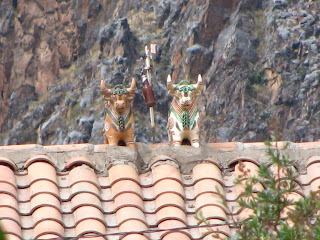
many people in the highlands display a pair of toritos, or little bulls, on their houses as a kind of talisman (this picture also neatly shows off the zoom capabilities of my new camera: when this picture was taken we were sitting at a restaurant all the way across the plaza--yes, even Ollantaytambo has one--about 300 meters away. the camera is at full 40X zoom and not supported by a tripod, yet see how nicely the picture turned out). below, the kind of native dress that makes the region famous began to pop up all over the place.

what we found there was, although of course touristy, so much different to the big city of Lima and even the bustling Cusco. this was a real highland village, and we began to see many people dressed in the native style, and apparently for their own reasons and not just so they could sell themselves for pictures with tourists. either way it was a nice, sleepy town and we were early for the train that would take us the rest of the way to Aguas Calientes, so we settled down to an early lunch of "pizza" and Inca Kola at a small family-run place on one side of the plaza. the Inca Kola was pretty much standard but the pizza, while not bad, might have been better described as some slightly soggy bread with a whole bunch of cheese on it. but pizza retaurants are all the rage in Peru, and we had been told that when in doubt, they were usually the safe place to eat, so we did.
and then we started to wander around town, which was when we came across Juan Diego:

Juan Diego serenades Jill in appreciation for her kind donation.
his sign reads as follows:
ME LLAMO JUAN DieGO
I am BLiNd
THanK you FOR youR DONATiON
GOd BLess you
SOy INVIDENTE
GRacias por su DoNacioNes
y que Dios Los BeNDiGA
Juan Diego was sitting outside the gate for the Ollantaytambo ruins and, with his strange harp-like instrument played and sang a quite haunting tune to Jill:
we decided not to pay the fairly high entrance fee for the Ollanta ruins, reasoning that we would soon be getting quite a fill of other ruins just up the road (or track), but there were all kinds of hewn-rock structures scattered over the hills surrounding the town. many of them blended in quite well and you would be looking around to admire the scenery and suddenly realize there were buildings there,camouflaged by their having been constructed with rock the same color as the mountains. they were all over the place.

the marketplace near the entrance to Ollanta's official ruins had all kind of wonderful things on sale, like this fun balaclava that i thought was something to do with Peru's version of lucha libre, but turned out to be for a type of traditional dance called the Capac Qolla. the mask itself is call a Waq'ollo and can be had in all color schemes imaginable, and is usually worn with a square, flat hat called an Aqarapi that is intricately adorned with antique coins dangling from its brim. at one point we actually caught a couple of brief glimpses of this dance being performed for some other tour group as our train passed theirs. below, the market and some of its other wares in context of their dramatic surroundings, made more so by the ancient buildings almost hiding scattered in the hills.

after the market we made our way down towards the Urubamba river to catch our train, which would follow that water course through ever-deepening canyons to Aguas Calientes. progress on the train was slow, taking about two hours to cover something like 25 as-the-crow-flies miles, but the scenery was beautiful and the dryness of the open valleys began to give way to descending mists that laced the mountain trees.

Jill tries out some of Ollanta's "flying" steps made of cantilevered rocks in a wall, an effect we would see more of at Machu Picchu. below, the train we were about to get on to go there:

and that was it. we were finally almost where we had come all that way to be, and with just enough time to grab an early dinner and head for 7:30 bedtime. we had thought getting up at five to leave Lima was pretty intense, but that was nothing compared with the sleep sacrifice we made to ensure an early arrival at Machu Picchu.

five minutes out of Lima and the mountains are already over 10,000 feet. the wing is that of our small but new TACA Airlines Airbus A319, a comfortable ride even at that early hour.
to catch the 7am flight we were up before five, but getting to Cusco didn't mean we could slow down. we were on our way to the town at the base of Machu Picchu, called Aguas Calientes, and for much of that distance there is no road. many people take the high-priced train all the way from Cusco to Aguas Calientes, but we decided to break the journey up and go part way by road.

scenes from the beautiful Sacred Valley region of Peru, between Cusco to the south and Ollantaytambo northwest of there. below, Jill and i were glad for the wise luggage choices we had made, especially given the cramped bus conditions on the way through the Sacred Valley; what you see in the picture is our entire compliment of luggage for the whole nearly two-week trip. genius!

after getting our bearings and taking a moment at Cusco's Plaza de Armas (did i mention all Peruvian cities have at least one square, or plaza?) to observe our third anniversary, we went in search of a bus station and began the very crowded, though thankfully cheap, drive to Urubamba. conveniently, the bus terminus in Urubamba was the departure point for a whole bunch of minivan taxis, or combis, so we crammed into one of those for the remainder of the trip to Ollantaytambo, the end of the road.

many people in the highlands display a pair of toritos, or little bulls, on their houses as a kind of talisman (this picture also neatly shows off the zoom capabilities of my new camera: when this picture was taken we were sitting at a restaurant all the way across the plaza--yes, even Ollantaytambo has one--about 300 meters away. the camera is at full 40X zoom and not supported by a tripod, yet see how nicely the picture turned out). below, the kind of native dress that makes the region famous began to pop up all over the place.

what we found there was, although of course touristy, so much different to the big city of Lima and even the bustling Cusco. this was a real highland village, and we began to see many people dressed in the native style, and apparently for their own reasons and not just so they could sell themselves for pictures with tourists. either way it was a nice, sleepy town and we were early for the train that would take us the rest of the way to Aguas Calientes, so we settled down to an early lunch of "pizza" and Inca Kola at a small family-run place on one side of the plaza. the Inca Kola was pretty much standard but the pizza, while not bad, might have been better described as some slightly soggy bread with a whole bunch of cheese on it. but pizza retaurants are all the rage in Peru, and we had been told that when in doubt, they were usually the safe place to eat, so we did.
and then we started to wander around town, which was when we came across Juan Diego:

Juan Diego serenades Jill in appreciation for her kind donation.
his sign reads as follows:
ME LLAMO JUAN DieGO
I am BLiNd
THanK you FOR youR DONATiON
GOd BLess you
SOy INVIDENTE
GRacias por su DoNacioNes
y que Dios Los BeNDiGA
Juan Diego was sitting outside the gate for the Ollantaytambo ruins and, with his strange harp-like instrument played and sang a quite haunting tune to Jill:
we decided not to pay the fairly high entrance fee for the Ollanta ruins, reasoning that we would soon be getting quite a fill of other ruins just up the road (or track), but there were all kinds of hewn-rock structures scattered over the hills surrounding the town. many of them blended in quite well and you would be looking around to admire the scenery and suddenly realize there were buildings there,camouflaged by their having been constructed with rock the same color as the mountains. they were all over the place.

the marketplace near the entrance to Ollanta's official ruins had all kind of wonderful things on sale, like this fun balaclava that i thought was something to do with Peru's version of lucha libre, but turned out to be for a type of traditional dance called the Capac Qolla. the mask itself is call a Waq'ollo and can be had in all color schemes imaginable, and is usually worn with a square, flat hat called an Aqarapi that is intricately adorned with antique coins dangling from its brim. at one point we actually caught a couple of brief glimpses of this dance being performed for some other tour group as our train passed theirs. below, the market and some of its other wares in context of their dramatic surroundings, made more so by the ancient buildings almost hiding scattered in the hills.

after the market we made our way down towards the Urubamba river to catch our train, which would follow that water course through ever-deepening canyons to Aguas Calientes. progress on the train was slow, taking about two hours to cover something like 25 as-the-crow-flies miles, but the scenery was beautiful and the dryness of the open valleys began to give way to descending mists that laced the mountain trees.

Jill tries out some of Ollanta's "flying" steps made of cantilevered rocks in a wall, an effect we would see more of at Machu Picchu. below, the train we were about to get on to go there:

and that was it. we were finally almost where we had come all that way to be, and with just enough time to grab an early dinner and head for 7:30 bedtime. we had thought getting up at five to leave Lima was pretty intense, but that was nothing compared with the sleep sacrifice we made to ensure an early arrival at Machu Picchu.


 people have been here already. see where they came from:


