it's probably been a bit difficult to follow the timeline of many of these posts, with me reporting events way after the fact and not in orderly fashion. but this post, though older like so many others lately, happens to report an event exactly two years old today. to mark this celebration of relative antiquity, and possibly to diminish the appearance of its age, i introduce the topic with some really vintage words:

the postcard advertising the bullfight we attended on our honeymoon in Puerto Vallarta, Mexico. 300 Mexican pesos was about US$27 at the time, and worth every penny.
nevertheless i have been somewhat fascinated with the idea of bullfighting, so i jumped at the chance to see a real live bullfight when Jill and i were last in Mexico, if only to make good on an event i thought i had observed a quarter century before. Jill was game too, which was convenient since we were on our honeymoon and it wouldn't really have done for me to go alone. even though it was held in the small bullring of Puerto Vallarta, a tourist town, the fights themselves were very authentic and it turns out that the fights are quite popular all over Mexico, and almost as much as in their native Spain.

me outside the Plaza de Toros in Puerto Vallarta, just before the appointed time.
if you've read this far then it's safe to assume that at least the idea of bullfighting doesn't put you off. i can understand how it would, and warn that there are some pretty graphic images to come, so i will understand if you take this last chance to bail out. but as Hemingway says, it's impossible to know your reaction to the spectacle until you've seen it, even though you may--very reasonably--never intend to do. unfortunately, there are some of the tourists in town on that day who had made up their minds about the barbarous event before it even started--why they still went was beyond me, it's not like anyone made them. one such woman insisted on shouting through the whole event and heckling the matadors and their peones, or underlings. she could have left, as several people did after or during the first fight, but her display not only served to confirm opinions that Americans can be obnoxious and culturally insensitive, but displayed a complete lack of understanding of the the whole bullfight.
though no excuse for her behavior, this ignorance is understandable, and comes from a basic misperception of the nature of the event. given that fights and matadors are given similar press coverage to the final four and NFL quarterbacks, it makes sense that we would think of the bullfight as sport, though sport it is really not:

the paseo of the bullfighters and their staff, or cuadrilla, occurs at the beginning of the event and allows a sense of occasion and a chance to salute the Presidente, the authority for the fight. below, the bull is announced before he thunders into the arena.

about an hour after the matadors have begun their highly ritualistic dressing in their ornate trajes de luces (suits of light), the late-afternoon event begins with a procession across the plaza de toros, or bullring. some important person, perhaps a local dignitary, will have been chosen to officiate at the fight, and this presidente will, upon being saluted, throw down the keys to the toril, or bullpen. the bulls are kept in semi-darkness for several hours preceeding the fight, so as to calm and rest them and hopefully keep them from splintering their horns by ramming the enclosure walls. the fighters will have sent trusted members of their staff to examine the bulls and draw for them, each one hoping to have a brave, usually meaning aggressive, bull. generally, three matadors will each kill two bulls; at the fight we attended there were four young matadors who each went up against a single toro.
the bulls are announced just before they are allowed to charge down the tunnel that leads out into the bright sunshine of the ring, which most do explosively, though one or two at our corrida, or running, required a jab in the hind quarters to get them going. perhaps oddly, these are the most dangerous bulls for the matadors because they will be unpredictable in their charges and will also require the most risk-taking in citing to charge. in any case, this is when the matador first gets to judge the character of his bull, as the man stands behind the barrera, the red wooden fence that surrounds the sandy ring and provides some protection from the bull's charges. the other matadors and the current fighter's own staff will enter the ring with their capotes, large, heavy capes used to attract the bull's attention and steer him in this prelude to the fight. they will often use them to lead the bull away from a horse or a man in vulnerable position in a maneuver known as a quite, which is also usually taken as a good chance to show off some fancy cape work.

one of the matadors uses the heavy rose and goldenrod-colored capote to attract the bull. you can tell that this is a full matador and not a peon because the ornaments of his traje de luces are gold.
during all this beginning activity, before the first of the fight's three acts, or tercios, has begun, the matador will be studying his bull to detect signs of cowardice or tendencies to prefer one horn over the other for hooking, or to veer to the left or right in charging. many of the actions taken during the fight will have the express purpose of correcting any of these undesirable traits. after a few minutes of observation, the matador himself will enter the arena and finish the introduction with a series of veronica, gaoneras, or other studied operations, citing the bull to charge past the cape as it is swirled in this way or that past the raging beast. this demonstrates the artistry of the fighter and also, after the media-veronica, a final half spin of the cape, serves to plant the bull in its last position, allowing the matador to walk away with his back to the horns, hinting at the mastery he hopes to gain over the bull in the coming 20 minutes or so. indeed, the killing of each bull is a relatively short procedure, and necessarily so due to the bull's being so quick to learn. after too much experience in the ring, any given bull becomes far too dangerous to fight, he knowing just what is going on and just how disrupt it, and so must be killed rather speedily. this is also why a bull will almost never leave the ring alive, whether the matador is able to kill him or not--he will never be able to be fought again because that next time he will surely kill the man, and though that may seem more sporting to some, remember that letting the bull have a chance is one thing, but letting him have an equal chance was never the idea.

the picador on his these-days-heavily-armored (and blindered) steed drives his pica, or vara, a long lance with a disc just to the rear of the point to prevent too-far penetration, into the shoulder muscle of the bull as other toreros, or bullfighters, wait to make the quite and lead the bull away from the horse after the encounter.
so now the first act of death commences, the tercio de varas, in which two picadors, or lance-wielding men on horseback, begin attacking the great hump of muscle that runs from just behind the bull's horns to the middle of its ribcage. much of the time in the three tercios is spent weakening this mass so that gradually the bull's head and horns will droop and enable the matador to reach in over them to secure his kill. the bull will usually be picced two, three or four times during the tercio de varas, and will still appear strong and high-headed afterwards even though a sheen of blood may be coursing down his flanks (which actually helps to lower the furious animal's blood pressure, keeping him from death by extreme acute hypertension). the picador should not have ruined the bull by piccing him in the ribcage or by grinding or twisting the vara, but should have, among other things, helped lower the furious animal's blood pressure, thus keeping him from death by heart attack, thus properly setting the stage for the next act, the tercio de banderillos.

some colorful banderillas with their barbed points hang awaiting use in the callejon, the narrow walkway separated from the ring by the red wooden barrera.
banderillas are two-foot long sticks with harpoon-like points at the end and covered the length of their shaft in brightly colored paper. the majority of the members of a matador's staff, or cuadrilla, are banderilleros, or placers of these sticks. the idea is again to jab them into the bull's hump of muscle, a pair at a time, only this time to remain under the hide, hanging by the barbs of their points. a banderillero, and sometimes the matador himself, will place one of up to four sets of banderillas as close together as possible by citing the bull for a charge and then running at the bull in a sort of arc and thrusting them downwards with arms extended high over the horns to allow them to come within range of the man. the following video demonstrates this reasonably well, though you will be able to see that the pair were not placed in great proximity to each other:
a peon places a pair of banderillas with some grace, if not much care. at least he got them on the correct side.
you should also have noticed that all of the banderillas had been placed on the right side of this bull, which was undoubtedly ordered by the matador to correct a tendency of that animal to veer or hook one way or the other. by the end of the tercio be banderillos, the bull should be as corrected as possible, and should have been weakened enough that the final series of cape passes will drop his head sufficiently for a kill, but he should not have been destroyed by being rendered lame or timid.

this bull follows the cape in its low arc along the sand. having finished the placement of the banderillas, we are now in the third act.
thus begins the tercio de muerte, the third of death--that of the bull if all goes correctly. it is with this third that most people in non-bullfighting nations would likely be familiar, the matador now doing his work alone with the small red muleta cape. probably less well known is the sword he will also have with him during most of this time, which he will use both to spread the cape and also to kill. somehow, we rarely get those last images, but it is that final moment that the whole fight has built to, a crescendo to a dramatic final showdown. without this it all comes to nothing. the moves with the cape in this act are collectively known as the faena, and are meant to highlight both the man's artistry and his mastery over the bull, not to mention his bravery. it is here that he can choose the degree of danger to which he is exposed by carefully controlling the distance from his own body that the bull's horn pass. his nervousness may be given away by feet that slide involuntarily away from the huge beast as he tramples past, or his fear may be revealed by great gaps between his skin-tight suit and the hooking horns that seek to deliver him a cornada, or goring. all the while seeking to avoid these giveaways, the matador must also strive to execute his passes with as much grace and beauty as possible.

some moves of the two most appealing fighters of our day at the ring: Pepe Murillo above, and the show-stopping Antonio Garcia below. some of Garcia's actions were pure theatrics, but he played the crowd well and knowing that he had planted the bull with a fine series of passes, could both kneel before it and turn his back on it without fear.
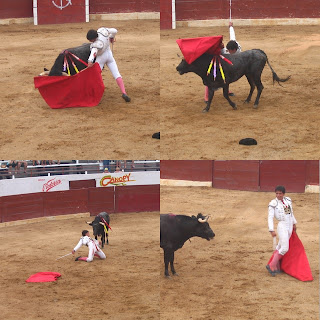
we didn't seem to get many pictures of Rodrigo Merino, the afternoon's first fighter, though i remember him seeming a bit awkward and lanky. Pepe Murillo was likewise tall but seemed graceful and was a pleasure to watch, though his kill was somewhat troubled and unremarkable. Antonio Garcia was anything but unremarkable, a bit over the top even, but the stars were aligned for him on that day and his work was tremendous in just about every way. and then came Christian Hernandez.

Christian Hernandez demonstrates a pase with the muleta; note his sword holding out the cape to make its area larger. a careful inspection will also reveal a nice low pass, intended to further tire the bull's shoulder muscle, but due to overzealousness in piccing (see the large tear in the flesh between the lower two banderillas) this bull is worn out enough to be brought almost to his knees. below, Hernandez sizes up his bull before citing for another charge. i like this picture so much (taken by Jill of course, to whom i dedicate this post as a reminder of our great honeymoon) that a copy hangs in my office.

following Garcia must have been difficult, and unfortunately Hernandez made it look just that. his passes were functional but not especially attractive, and his kill was actually quite disturbing, he seeming to have entirely lost his nerve by the time he actually took the sword. his bull didn't seem especially big but it may well have been a more difficult specimen than my untrained eyes could detect. despite these problems, the best pictures of the final phase of a fight came from this last matador, whose ever-redder face betrayed a growing embarrassment at the state of his corrida.

Hernandez salutes the presidente before the hora de verdad, or moment of truth, asking his permission to kill or perhaps dedicating the bull to him. below, Hernandez goes in volapie, sort of. this method of killing sees the man charge the bull, going in over the horns with the sword while keeping the bull's head down and steering him past with the muleta. sadly, Hernandez can be seen here already running away from the bull before he has even got close, which netted him a sword through the poor bull's lung and a loud series of whistles from the crowd. as a side note, you may wonder about the caked mud on the bull's rear; this is there to prevent messes in the ring.

so how does one kill a bull? after all the preparatory work is done, it comes down to (hopefully) one shot with a long, very sharp sword, called an estoque, which should be inserted between the shoulder blades in an opening that is formed as the bull's head is carried lower and lower. if done correctly this will sever the aorta, and the bull will very soon be dead, often before he hits the ground. the act of the estocada is done in one of two ways, the more common volapie, or "flying while running" toward the bull, style, and the more dangerous recibiendo manner, in which the man stands stock still and hopes the bull charges his muleta in a very straight path. it is at the moment of death that the bull really gets his best chance of the fight, that if the man is doing his job properly (ie, not like Christian Hernandez is doing above), the bull can raise his head for the last time and deliver a good and possibly fatal goring to the matador who seeks to put him out of commission. this is the hora de verdad: to see if the man will give the bull that chance. the following videos show first, what it looks like to run at a bull with the intent of killing him, and second, what it looks like after you've done that correctly:
Pepe Murillo demonstrates an estocada that is more or less correct, if not particularly pretty. you may note that the point of the sword has actually exited the bull, which may say more about the animal's size than it does about correct placement. you will note that Pepe is quite pleased with the result. below, you can see how quickly Antonio Garcia's bull drops after having received the sword from him on a first attempt. he is justly elated at the nice rounding out of what was a virtually perfect fight for him.
since we're watching videos, it may be worth taking a moment to note their wonderful soundtrack--indeed, the soundtrack of the bullfight itself. a corrida relies to some degree on the presence of live music, a band that sits by the presidente playing various paso dobles that are quite often fairly incongruous to the sight before you. in any case, they do a pretty good job with what they have, and it all adds to the atmosphere and, in our case, helped to drown out that large, obnoxious American woman. all the shouts of ole! as each pass was made helped there too.

the noble beast is dragged out of the plaza in a rather unceremonious fashion. at least there's a brass band playing.
but what happens if you can't kill the bull, as in the case of poor Christian Hernandez? you try again, and possibly again, until the crowd starts their loud whistling, petitioning the presidente to either end the butchery or allow a particularly valorous bull to be put out to pasture as a stud. if he is to be put out of his misery, the matador may be allowed to use a special sword or even a dagger to sever the spinal cord just at the base of the skull. this is what Christian had to do.
how about in the case of a clean kill? just as the one Garcia demonstrated, the matador cites the bull to charge and drags the muleta, held in the left hand, low to keep the bull's head down, making him pass to the fighter's right, while he leans in over the horns to drive home the estoque with his right hand. as you saw above, the bull will remain standing for only a short time before he collapses. and rather than whistles there will be a waving of white handkerchiefs, signalling to the presidente that the crowd favors the awarding of trofeos, or trophies. these will be an ear or two and may even include the bull's tail in exceptionally proficient cases, and will be added to the victory lap of the ring that a clean kill will inspire. Garcia was awarded both ears of his bull.

after his fight Antonio Garcia thanks the crowd and again salutes the presidente, before taking his lap of the ring with his trofeos of two ears in hand. the blood on his traje de luces indicates the closeness with which he worked the bull during the faena.
and then the fight is over. the matadors retrieve their ceremonial capes from the people in the audience to whom they had entrusted them as a sign of respect at the beginning; if one is draped over the barrera in front of your seat and the fighter does well it is a mark of great honor, if he does less well you may be tempted to slink away from it after the fight. the matadors and their cuadrillas gather to pack their equipment and talk about the bulls, perhaps offering encouragement to the fighter of that very difficult one.

the torreros gather following the corrida, with members of the cuadrilla gathering the swords and capes from the callejon. here again you can see that the full matadors, with the exception of Antonio Garcia, in white, have their trajes ornamented in gold, to distinguish them from the peones. below, a solemn senior banderillero carefully folds a heavy capote for future use.

so as we begin the summation it's fair to note that the corrida we saw could be indicted on a number of grounds, not least of which were certain annoying spectators. besides that the bulls were small, the fighters generally worked with too great a margin of safety or too many tricks, and you could even argue that it, like all bullfights, was just a barbarous, cruel business plain and simple. we didn't see any of the horsey trauma Hemingway said we would, due to the extensive padding those animals now get to wear, but i suspect that any such deaths would be more troubling than any we did see. a horse, when killed, is good only for glue or dog food, whereas the bull is actually taken and his parts used practically in their entirety. i'm not going to be an apologist for the bullfight, and i really do understand how someone could have a real problem with it, but i'd say it's better that the bull get to provide a show and demonstrate his bravery than that he gets a simple, unceremonious mallet blow to the head in some filthy slaughterhouse. besides, that person with the real problem is welcome to stay away. though they are never allowed to fight humans while growing up, these bulls are bred for fighting and are kept just as you would expect very valuable animals to be: as kings. their time in the ring is their end purpose in life.

the fights are a serious business and will be reported in the press even in the case of a minor venue like Puerto Vallarta. above, Antonio Garcia is interviewed on camera, while Jill and i pose with the victor below.

and so having seen it, i can now make my end judgment, and tell you whether i have that fineness of feeling spoken of to revile this slaughter. alas, i do not. while i might not say i have developed true aficion for the bullfight, i am interested by it, and it is definitely a fascinating spectacle. Jill, too, decided that she really rather enjoyed it, and we have plans to see another running later this year. i'd have to say that looking at the pictures and videos is actually a lot less interesting and perhaps more troubling than seeing the real thing live, so if you got to this point, without any trouble or upset you're probably ready for the real thing. next time you're in Mexico, or better yet, Spain, or even a number of other South American countries, try to catch a bullfight and if nothing else discover what your true reaction to it is.
for reference, should you like some on this topic, a few recommendations follow. certainly the place to start would be Hemingway's Death in the Afternoon, pretty much the English language bible of bullfighting. though somewhat dated, having been first published in 1932, it is still an excellent and thorough guide and would be quite profitably read before seeing a bullfight for the first time. his other work of nonfiction, The Dangerous Summer, about a season of dueling matadors, is also a good read, and the fictional The Sun Also Rises has some nice references to the art and is highly enjoyable as a novel as well.
for immediate satisfaction, the Encyclopedia Britannica has a lengthy and informative article online, and the Wikipedia article isn't that bad, although it does change from time to time. there is a very helpful FAQ available online from a company which runs tours to the Tijuana bullring, which answers a lot of basic questions quite well.
ESPN Magazine has an interesting article about a young Mexican matador which includes some great pictures, and its Sports Travel website has at least a couple of bullfight articles that may be more or less useful. finally, there are apparently a number of bullfighting clubs right here in the United States that maintain websites, including the LA Bullfight Club and the Club Taurino de Chula Vista, both members of the National Association of Taurine Clubs. i didn't know there were that many either.
At the first bullfight I ever went to I expected to be horrified and perhaps sickened by what I had been told would happen to the horses. Everything I had read about the bullring insisted on that point; most people who wrote of it condemned bullfighting outright as a stupid brutal business, but even those that spoke well of it as an exhibition of skill and as a spectacle deplored the use of the horses and were apologetic about the whole thing. The killing of the horses in the ring was considered indefensible. I suppose, from a modern moral point of view, that is, a Christian point of view, the whole bullfight is indefensible; there is certainly much cruelty, there is always danger, either sought or unlooked for, and there is always death, and I should not try to defend it now, only to tell honestly the things I have found true about it. To do this I must be altogether frank, or try to be, and if those who read this decide with disgust that it is written by some one who lacks their, the readers', fineness of feeling I can only plead that this may be true. But whoever reads this can only truly make such a judgment when he, or she, has seen the things that are spoken of and knows truly what their reactions to them would be.so saith Ernest Hemingway, who penned these words more than 75 years ago, and who, at least in the English language, is perhaps the most studied observer of modern bullfighting, modern here being within the last century. i have lived most of my life thinking that my family had attended bullfights during our trips to Spain when i was a young child of three or four; apparently i was wrong about that but i'm sure i wouldn't have remembered my reactions even if i had attended one those many years ago.

the postcard advertising the bullfight we attended on our honeymoon in Puerto Vallarta, Mexico. 300 Mexican pesos was about US$27 at the time, and worth every penny.
nevertheless i have been somewhat fascinated with the idea of bullfighting, so i jumped at the chance to see a real live bullfight when Jill and i were last in Mexico, if only to make good on an event i thought i had observed a quarter century before. Jill was game too, which was convenient since we were on our honeymoon and it wouldn't really have done for me to go alone. even though it was held in the small bullring of Puerto Vallarta, a tourist town, the fights themselves were very authentic and it turns out that the fights are quite popular all over Mexico, and almost as much as in their native Spain.
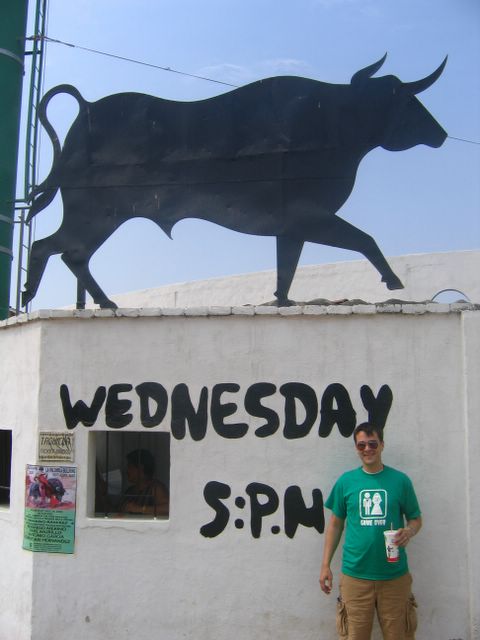
me outside the Plaza de Toros in Puerto Vallarta, just before the appointed time.
if you've read this far then it's safe to assume that at least the idea of bullfighting doesn't put you off. i can understand how it would, and warn that there are some pretty graphic images to come, so i will understand if you take this last chance to bail out. but as Hemingway says, it's impossible to know your reaction to the spectacle until you've seen it, even though you may--very reasonably--never intend to do. unfortunately, there are some of the tourists in town on that day who had made up their minds about the barbarous event before it even started--why they still went was beyond me, it's not like anyone made them. one such woman insisted on shouting through the whole event and heckling the matadors and their peones, or underlings. she could have left, as several people did after or during the first fight, but her display not only served to confirm opinions that Americans can be obnoxious and culturally insensitive, but displayed a complete lack of understanding of the the whole bullfight.
though no excuse for her behavior, this ignorance is understandable, and comes from a basic misperception of the nature of the event. given that fights and matadors are given similar press coverage to the final four and NFL quarterbacks, it makes sense that we would think of the bullfight as sport, though sport it is really not:
The bullfight is not a sport in the Anglo-Saxon sense of the word, that is, it is not an equal contest or an attempt at an equal contest between a bull and a man. Rather it is a tragedy; the death of the bull, which is played, more or less well, by the bull and the man involved and in which there is danger for the man but certain death for the animal.thanks to Senor Ernesto for the for the correct definition. the bullfight is art.

the paseo of the bullfighters and their staff, or cuadrilla, occurs at the beginning of the event and allows a sense of occasion and a chance to salute the Presidente, the authority for the fight. below, the bull is announced before he thunders into the arena.

about an hour after the matadors have begun their highly ritualistic dressing in their ornate trajes de luces (suits of light), the late-afternoon event begins with a procession across the plaza de toros, or bullring. some important person, perhaps a local dignitary, will have been chosen to officiate at the fight, and this presidente will, upon being saluted, throw down the keys to the toril, or bullpen. the bulls are kept in semi-darkness for several hours preceeding the fight, so as to calm and rest them and hopefully keep them from splintering their horns by ramming the enclosure walls. the fighters will have sent trusted members of their staff to examine the bulls and draw for them, each one hoping to have a brave, usually meaning aggressive, bull. generally, three matadors will each kill two bulls; at the fight we attended there were four young matadors who each went up against a single toro.
the bulls are announced just before they are allowed to charge down the tunnel that leads out into the bright sunshine of the ring, which most do explosively, though one or two at our corrida, or running, required a jab in the hind quarters to get them going. perhaps oddly, these are the most dangerous bulls for the matadors because they will be unpredictable in their charges and will also require the most risk-taking in citing to charge. in any case, this is when the matador first gets to judge the character of his bull, as the man stands behind the barrera, the red wooden fence that surrounds the sandy ring and provides some protection from the bull's charges. the other matadors and the current fighter's own staff will enter the ring with their capotes, large, heavy capes used to attract the bull's attention and steer him in this prelude to the fight. they will often use them to lead the bull away from a horse or a man in vulnerable position in a maneuver known as a quite, which is also usually taken as a good chance to show off some fancy cape work.

one of the matadors uses the heavy rose and goldenrod-colored capote to attract the bull. you can tell that this is a full matador and not a peon because the ornaments of his traje de luces are gold.
during all this beginning activity, before the first of the fight's three acts, or tercios, has begun, the matador will be studying his bull to detect signs of cowardice or tendencies to prefer one horn over the other for hooking, or to veer to the left or right in charging. many of the actions taken during the fight will have the express purpose of correcting any of these undesirable traits. after a few minutes of observation, the matador himself will enter the arena and finish the introduction with a series of veronica, gaoneras, or other studied operations, citing the bull to charge past the cape as it is swirled in this way or that past the raging beast. this demonstrates the artistry of the fighter and also, after the media-veronica, a final half spin of the cape, serves to plant the bull in its last position, allowing the matador to walk away with his back to the horns, hinting at the mastery he hopes to gain over the bull in the coming 20 minutes or so. indeed, the killing of each bull is a relatively short procedure, and necessarily so due to the bull's being so quick to learn. after too much experience in the ring, any given bull becomes far too dangerous to fight, he knowing just what is going on and just how disrupt it, and so must be killed rather speedily. this is also why a bull will almost never leave the ring alive, whether the matador is able to kill him or not--he will never be able to be fought again because that next time he will surely kill the man, and though that may seem more sporting to some, remember that letting the bull have a chance is one thing, but letting him have an equal chance was never the idea.
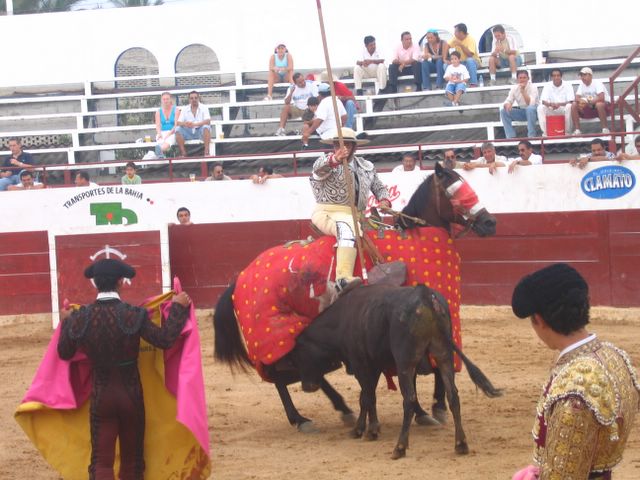
the picador on his these-days-heavily-armored (and blindered) steed drives his pica, or vara, a long lance with a disc just to the rear of the point to prevent too-far penetration, into the shoulder muscle of the bull as other toreros, or bullfighters, wait to make the quite and lead the bull away from the horse after the encounter.
so now the first act of death commences, the tercio de varas, in which two picadors, or lance-wielding men on horseback, begin attacking the great hump of muscle that runs from just behind the bull's horns to the middle of its ribcage. much of the time in the three tercios is spent weakening this mass so that gradually the bull's head and horns will droop and enable the matador to reach in over them to secure his kill. the bull will usually be picced two, three or four times during the tercio de varas, and will still appear strong and high-headed afterwards even though a sheen of blood may be coursing down his flanks (which actually helps to lower the furious animal's blood pressure, keeping him from death by extreme acute hypertension). the picador should not have ruined the bull by piccing him in the ribcage or by grinding or twisting the vara, but should have, among other things, helped lower the furious animal's blood pressure, thus keeping him from death by heart attack, thus properly setting the stage for the next act, the tercio de banderillos.
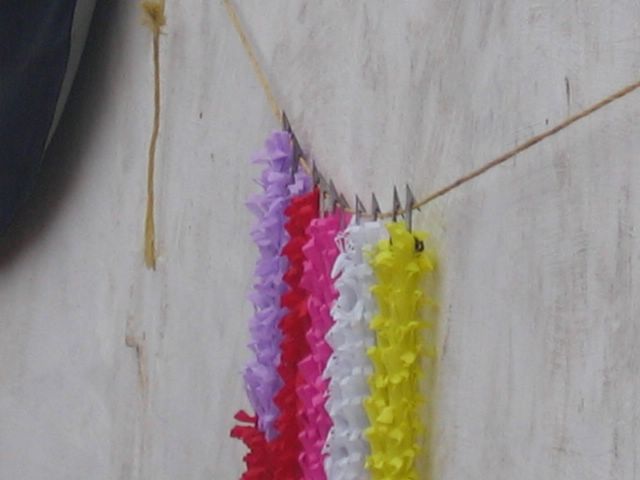
some colorful banderillas with their barbed points hang awaiting use in the callejon, the narrow walkway separated from the ring by the red wooden barrera.
banderillas are two-foot long sticks with harpoon-like points at the end and covered the length of their shaft in brightly colored paper. the majority of the members of a matador's staff, or cuadrilla, are banderilleros, or placers of these sticks. the idea is again to jab them into the bull's hump of muscle, a pair at a time, only this time to remain under the hide, hanging by the barbs of their points. a banderillero, and sometimes the matador himself, will place one of up to four sets of banderillas as close together as possible by citing the bull for a charge and then running at the bull in a sort of arc and thrusting them downwards with arms extended high over the horns to allow them to come within range of the man. the following video demonstrates this reasonably well, though you will be able to see that the pair were not placed in great proximity to each other:
a peon places a pair of banderillas with some grace, if not much care. at least he got them on the correct side.
you should also have noticed that all of the banderillas had been placed on the right side of this bull, which was undoubtedly ordered by the matador to correct a tendency of that animal to veer or hook one way or the other. by the end of the tercio be banderillos, the bull should be as corrected as possible, and should have been weakened enough that the final series of cape passes will drop his head sufficiently for a kill, but he should not have been destroyed by being rendered lame or timid.
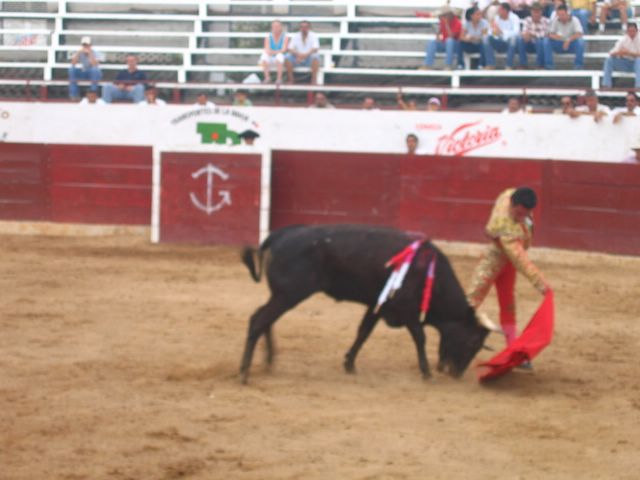
this bull follows the cape in its low arc along the sand. having finished the placement of the banderillas, we are now in the third act.
thus begins the tercio de muerte, the third of death--that of the bull if all goes correctly. it is with this third that most people in non-bullfighting nations would likely be familiar, the matador now doing his work alone with the small red muleta cape. probably less well known is the sword he will also have with him during most of this time, which he will use both to spread the cape and also to kill. somehow, we rarely get those last images, but it is that final moment that the whole fight has built to, a crescendo to a dramatic final showdown. without this it all comes to nothing. the moves with the cape in this act are collectively known as the faena, and are meant to highlight both the man's artistry and his mastery over the bull, not to mention his bravery. it is here that he can choose the degree of danger to which he is exposed by carefully controlling the distance from his own body that the bull's horn pass. his nervousness may be given away by feet that slide involuntarily away from the huge beast as he tramples past, or his fear may be revealed by great gaps between his skin-tight suit and the hooking horns that seek to deliver him a cornada, or goring. all the while seeking to avoid these giveaways, the matador must also strive to execute his passes with as much grace and beauty as possible.

some moves of the two most appealing fighters of our day at the ring: Pepe Murillo above, and the show-stopping Antonio Garcia below. some of Garcia's actions were pure theatrics, but he played the crowd well and knowing that he had planted the bull with a fine series of passes, could both kneel before it and turn his back on it without fear.

we didn't seem to get many pictures of Rodrigo Merino, the afternoon's first fighter, though i remember him seeming a bit awkward and lanky. Pepe Murillo was likewise tall but seemed graceful and was a pleasure to watch, though his kill was somewhat troubled and unremarkable. Antonio Garcia was anything but unremarkable, a bit over the top even, but the stars were aligned for him on that day and his work was tremendous in just about every way. and then came Christian Hernandez.
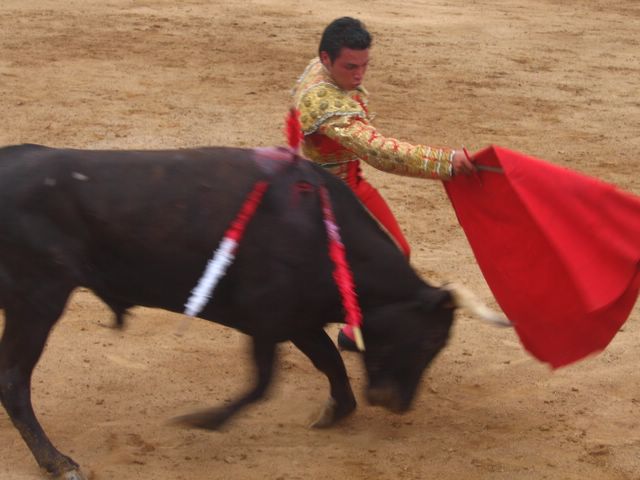
Christian Hernandez demonstrates a pase with the muleta; note his sword holding out the cape to make its area larger. a careful inspection will also reveal a nice low pass, intended to further tire the bull's shoulder muscle, but due to overzealousness in piccing (see the large tear in the flesh between the lower two banderillas) this bull is worn out enough to be brought almost to his knees. below, Hernandez sizes up his bull before citing for another charge. i like this picture so much (taken by Jill of course, to whom i dedicate this post as a reminder of our great honeymoon) that a copy hangs in my office.
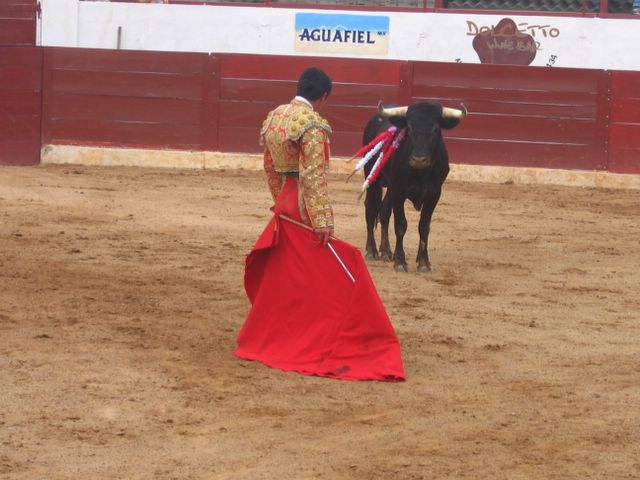
following Garcia must have been difficult, and unfortunately Hernandez made it look just that. his passes were functional but not especially attractive, and his kill was actually quite disturbing, he seeming to have entirely lost his nerve by the time he actually took the sword. his bull didn't seem especially big but it may well have been a more difficult specimen than my untrained eyes could detect. despite these problems, the best pictures of the final phase of a fight came from this last matador, whose ever-redder face betrayed a growing embarrassment at the state of his corrida.

Hernandez salutes the presidente before the hora de verdad, or moment of truth, asking his permission to kill or perhaps dedicating the bull to him. below, Hernandez goes in volapie, sort of. this method of killing sees the man charge the bull, going in over the horns with the sword while keeping the bull's head down and steering him past with the muleta. sadly, Hernandez can be seen here already running away from the bull before he has even got close, which netted him a sword through the poor bull's lung and a loud series of whistles from the crowd. as a side note, you may wonder about the caked mud on the bull's rear; this is there to prevent messes in the ring.
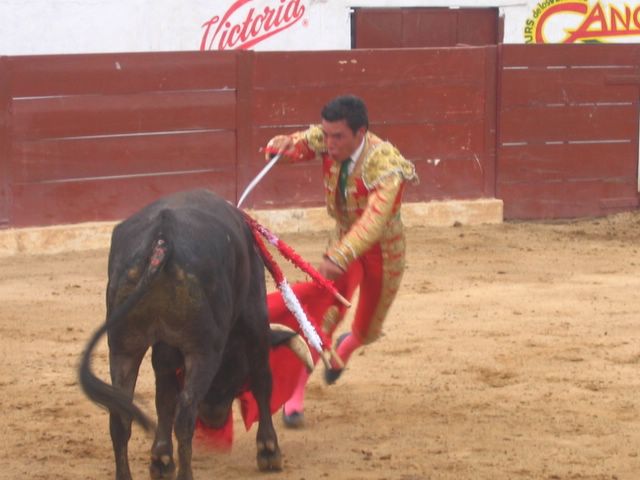
so how does one kill a bull? after all the preparatory work is done, it comes down to (hopefully) one shot with a long, very sharp sword, called an estoque, which should be inserted between the shoulder blades in an opening that is formed as the bull's head is carried lower and lower. if done correctly this will sever the aorta, and the bull will very soon be dead, often before he hits the ground. the act of the estocada is done in one of two ways, the more common volapie, or "flying while running" toward the bull, style, and the more dangerous recibiendo manner, in which the man stands stock still and hopes the bull charges his muleta in a very straight path. it is at the moment of death that the bull really gets his best chance of the fight, that if the man is doing his job properly (ie, not like Christian Hernandez is doing above), the bull can raise his head for the last time and deliver a good and possibly fatal goring to the matador who seeks to put him out of commission. this is the hora de verdad: to see if the man will give the bull that chance. the following videos show first, what it looks like to run at a bull with the intent of killing him, and second, what it looks like after you've done that correctly:
Pepe Murillo demonstrates an estocada that is more or less correct, if not particularly pretty. you may note that the point of the sword has actually exited the bull, which may say more about the animal's size than it does about correct placement. you will note that Pepe is quite pleased with the result. below, you can see how quickly Antonio Garcia's bull drops after having received the sword from him on a first attempt. he is justly elated at the nice rounding out of what was a virtually perfect fight for him.
since we're watching videos, it may be worth taking a moment to note their wonderful soundtrack--indeed, the soundtrack of the bullfight itself. a corrida relies to some degree on the presence of live music, a band that sits by the presidente playing various paso dobles that are quite often fairly incongruous to the sight before you. in any case, they do a pretty good job with what they have, and it all adds to the atmosphere and, in our case, helped to drown out that large, obnoxious American woman. all the shouts of ole! as each pass was made helped there too.
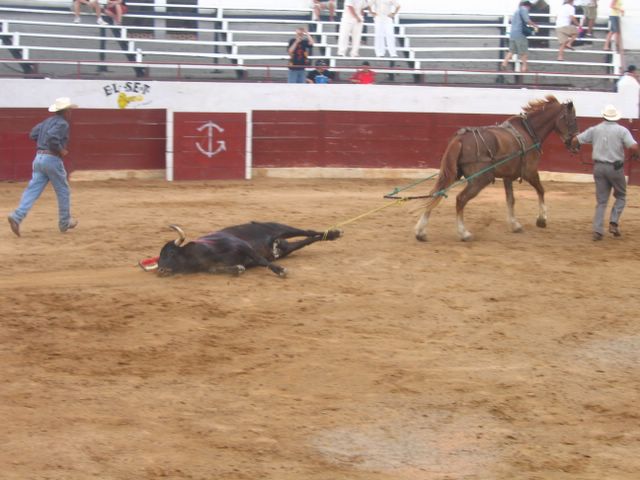
the noble beast is dragged out of the plaza in a rather unceremonious fashion. at least there's a brass band playing.
but what happens if you can't kill the bull, as in the case of poor Christian Hernandez? you try again, and possibly again, until the crowd starts their loud whistling, petitioning the presidente to either end the butchery or allow a particularly valorous bull to be put out to pasture as a stud. if he is to be put out of his misery, the matador may be allowed to use a special sword or even a dagger to sever the spinal cord just at the base of the skull. this is what Christian had to do.
how about in the case of a clean kill? just as the one Garcia demonstrated, the matador cites the bull to charge and drags the muleta, held in the left hand, low to keep the bull's head down, making him pass to the fighter's right, while he leans in over the horns to drive home the estoque with his right hand. as you saw above, the bull will remain standing for only a short time before he collapses. and rather than whistles there will be a waving of white handkerchiefs, signalling to the presidente that the crowd favors the awarding of trofeos, or trophies. these will be an ear or two and may even include the bull's tail in exceptionally proficient cases, and will be added to the victory lap of the ring that a clean kill will inspire. Garcia was awarded both ears of his bull.

after his fight Antonio Garcia thanks the crowd and again salutes the presidente, before taking his lap of the ring with his trofeos of two ears in hand. the blood on his traje de luces indicates the closeness with which he worked the bull during the faena.
and then the fight is over. the matadors retrieve their ceremonial capes from the people in the audience to whom they had entrusted them as a sign of respect at the beginning; if one is draped over the barrera in front of your seat and the fighter does well it is a mark of great honor, if he does less well you may be tempted to slink away from it after the fight. the matadors and their cuadrillas gather to pack their equipment and talk about the bulls, perhaps offering encouragement to the fighter of that very difficult one.
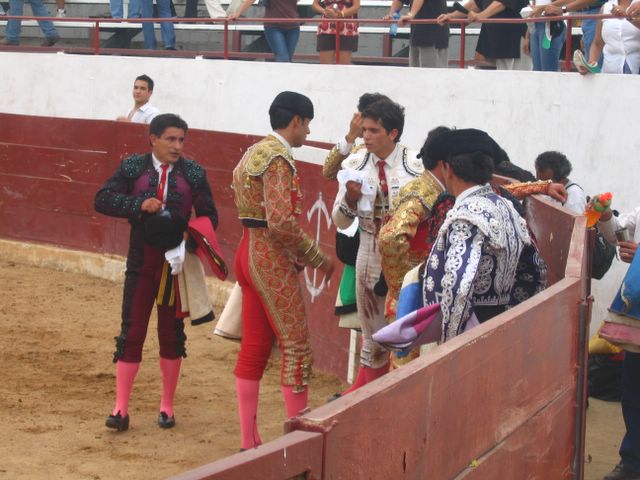
the torreros gather following the corrida, with members of the cuadrilla gathering the swords and capes from the callejon. here again you can see that the full matadors, with the exception of Antonio Garcia, in white, have their trajes ornamented in gold, to distinguish them from the peones. below, a solemn senior banderillero carefully folds a heavy capote for future use.

so as we begin the summation it's fair to note that the corrida we saw could be indicted on a number of grounds, not least of which were certain annoying spectators. besides that the bulls were small, the fighters generally worked with too great a margin of safety or too many tricks, and you could even argue that it, like all bullfights, was just a barbarous, cruel business plain and simple. we didn't see any of the horsey trauma Hemingway said we would, due to the extensive padding those animals now get to wear, but i suspect that any such deaths would be more troubling than any we did see. a horse, when killed, is good only for glue or dog food, whereas the bull is actually taken and his parts used practically in their entirety. i'm not going to be an apologist for the bullfight, and i really do understand how someone could have a real problem with it, but i'd say it's better that the bull get to provide a show and demonstrate his bravery than that he gets a simple, unceremonious mallet blow to the head in some filthy slaughterhouse. besides, that person with the real problem is welcome to stay away. though they are never allowed to fight humans while growing up, these bulls are bred for fighting and are kept just as you would expect very valuable animals to be: as kings. their time in the ring is their end purpose in life.

the fights are a serious business and will be reported in the press even in the case of a minor venue like Puerto Vallarta. above, Antonio Garcia is interviewed on camera, while Jill and i pose with the victor below.

and so having seen it, i can now make my end judgment, and tell you whether i have that fineness of feeling spoken of to revile this slaughter. alas, i do not. while i might not say i have developed true aficion for the bullfight, i am interested by it, and it is definitely a fascinating spectacle. Jill, too, decided that she really rather enjoyed it, and we have plans to see another running later this year. i'd have to say that looking at the pictures and videos is actually a lot less interesting and perhaps more troubling than seeing the real thing live, so if you got to this point, without any trouble or upset you're probably ready for the real thing. next time you're in Mexico, or better yet, Spain, or even a number of other South American countries, try to catch a bullfight and if nothing else discover what your true reaction to it is.
for reference, should you like some on this topic, a few recommendations follow. certainly the place to start would be Hemingway's Death in the Afternoon, pretty much the English language bible of bullfighting. though somewhat dated, having been first published in 1932, it is still an excellent and thorough guide and would be quite profitably read before seeing a bullfight for the first time. his other work of nonfiction, The Dangerous Summer, about a season of dueling matadors, is also a good read, and the fictional The Sun Also Rises has some nice references to the art and is highly enjoyable as a novel as well.
for immediate satisfaction, the Encyclopedia Britannica has a lengthy and informative article online, and the Wikipedia article isn't that bad, although it does change from time to time. there is a very helpful FAQ available online from a company which runs tours to the Tijuana bullring, which answers a lot of basic questions quite well.
ESPN Magazine has an interesting article about a young Mexican matador which includes some great pictures, and its Sports Travel website has at least a couple of bullfight articles that may be more or less useful. finally, there are apparently a number of bullfighting clubs right here in the United States that maintain websites, including the LA Bullfight Club and the Club Taurino de Chula Vista, both members of the National Association of Taurine Clubs. i didn't know there were that many either.




 people have been here already. see where they came from:


